In the quiet district of Xiaogan, beneath the watchful eye of De’an Prefecture, lived a young scholar named Xu Xianzhong. At eighteen, he was the very picture of scholarly elegance—his features as refined as ink-wash painting, his brows like distant hills, and his eyes clear as autumn streams. Across the narrow lane stood the house of Xiao Fuhan, a butcher of sturdy build. In the inner chambers of that house lived his daughter, Shuyu, a girl of seventeen whose beauty was quiet, arresting, and seldom seen by the world.
While the street below bustled with the noise of commerce, Shuyu sat at her embroidery frame in the upstairs room, her needle weaving peonies and phoenixes. It was from this window, overlooking the street, that she first saw the young scholar pass by. A glance. A heartbeat’s hesitation. He looked up; she looked down. In that silent exchange, something unspoken passed between them—a connection as delicate and undeniable as the scent of osmanthus on a still autumn night.
Days turned to weeks. Glances became smiles, and smiles became whispered words in the twilight. One evening, under a low-hanging moon, Xu Xianzhong dared to speak the truth that hung heavy in the air. Shuyu lowered her gaze and gave the faintest nod.
That night, he set a ladder against her wall and climbed into a world of silk curtains and pounding hearts. They came together with the fierce tenderness of first love. When the rooster crowed at dawn, he slipped away with a promise on his lips: Tonight. Again.
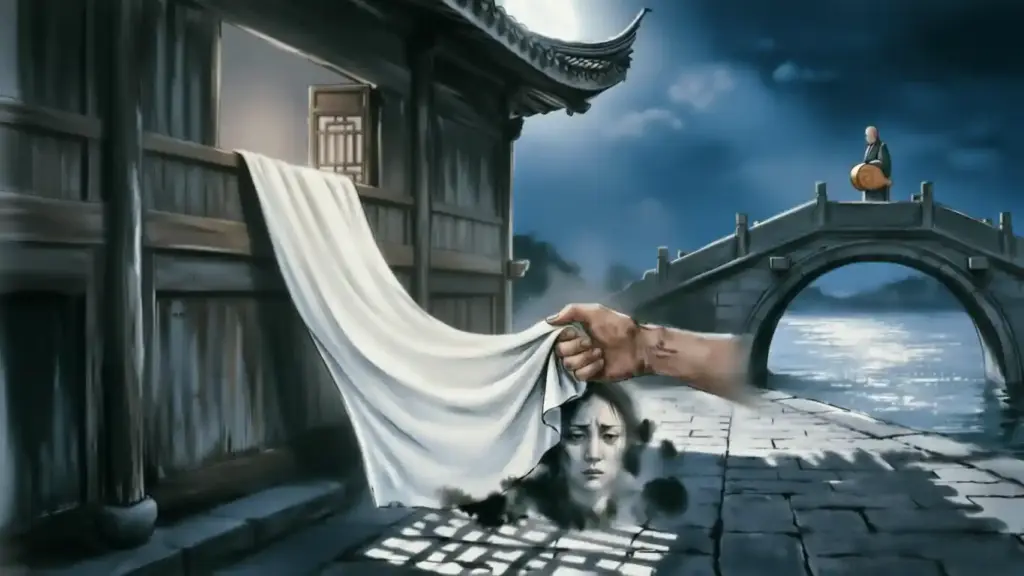
Shuyu, ever thoughtful, devised a safer arrangement. “A ladder leaning against the wall will draw eyes in the dark,” she whispered. “I will fix a round beam above the window and hang a length of white cloth from it—half over the beam, half dangling down to the street. When you come, grasp the cloth, and I shall pull you up myself.”
He was overjoyed. That very night, he came as instructed. The white cloth became their secret path, a slender bridge between longing and fulfillment. For half a year, they met this way. Neighbors began to whisper, but Xiao Fuhan remained as oblivious as a man sleeping through a thunderstorm.
Then came a night heavy with ill omen. Xu Xianzhong was detained at a friend’s wine gathering and failed to come at the appointed hour. The street lay empty under a sliver of moon when a Buddhist monk named Mingxiu passed by, tapping his wooden fish and chanting his nightly alms. His eyes fell upon the white cloth hanging from the upper window, pale as a ghost in the darkness.
Careless household, he thought. Left the cloth out to air.
Greed stirred within him. He crept close, meaning only to steal it. But the moment his hand closed upon the fabric, he felt himself lifted from the ground. Startled, the monk quickly realized he had stumbled upon a lover’s contraption—a device for drawing a man into a woman’s chamber.
A sly, hungry grin spread across his face. He let himself be hauled upward.
When his feet touched the floorboards and he saw the girl—young, lovely, her cheeks flushed with expectancy that turned in an instant to frozen horror—his heart surged with dark delight.
“Little nun,” he said, his voice slick as oil, “fate has sent me to your window tonight. Grant me one evening’s shelter, and the merit shall be boundless.”
Shuyu recoiled. “I am bound to another, heart and body. I would sooner give you the silver hairpin from my head than my honour. Go. Go now, quickly.”
“You drew me up yourself,” the monk murmured, stepping closer. “Having come, I cannot leave.”
His hands reached for her, rough and insistent. She screamed, “Thief! There is a thief!” But the night swallowed her cry. Her parents, deep in slumber, heard nothing.
Mingxiu, panicking, drew his knife. He silenced her with one brutal stroke. Her blood bloomed across the silk cushions. He tore the hairpin from her head, the earrings from her lobes, the ring from her finger, and fled down the cloth rope into the waiting dark.
The next morning, Shuyu did not come down for breakfast. Her mother climbed the stairs to find her daughter’s body, cold and still, upon the blood-soaked bedding.
Who could have done such a thing? The neighbors, nursing their resentment of the secret affair, pointed fingers. “Your daughter has been receiving Xu Xianzhong for six months,” they told the grieving butcher. “Doubtless he returned drunk, forced himself upon her, and killed her in a rage.”
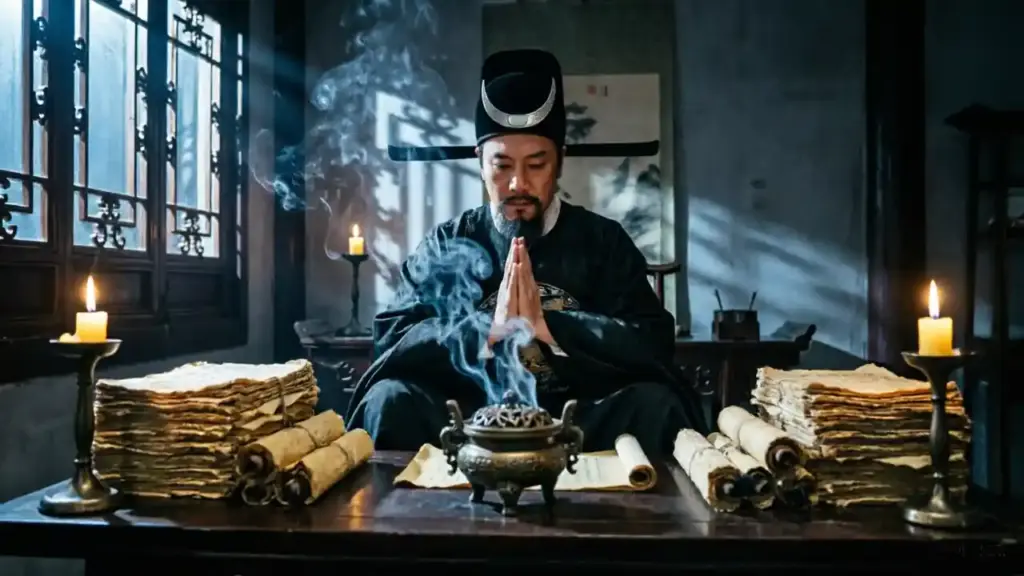
Xiao Fuhan, his grief hardening into vengeance, took his case to the court of Magistrate Bao—Lord Bao Zheng himself, whose wisdom was said to pierce the veil of heaven.
The petition was a howl of pain: “Malicious scholar Xu Xianzhong… forced his embrace upon her, and when she refused him, stabbed her to death. Her ornaments are missing, stolen by his hand. Justice, my lord! Justice!”
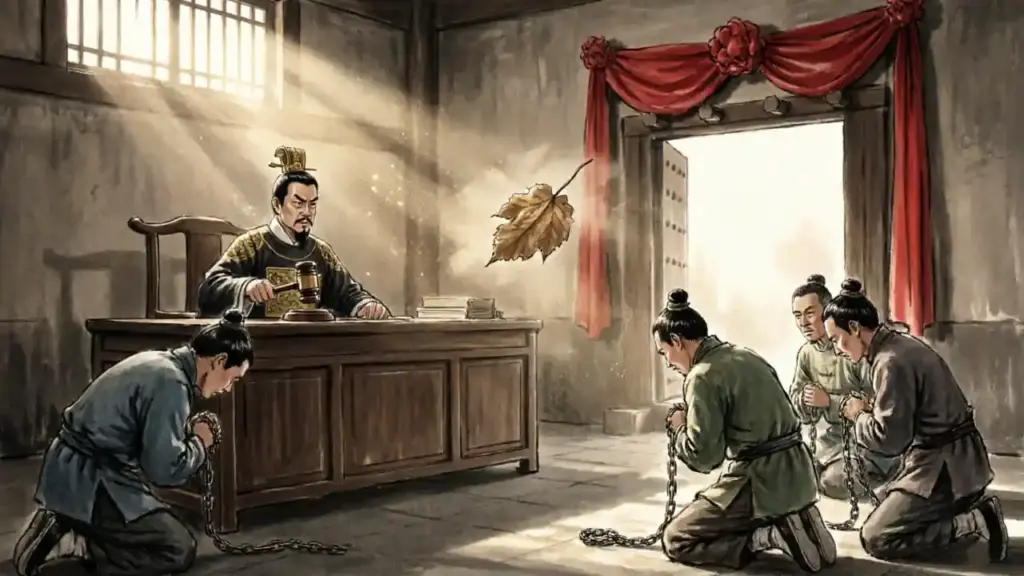
Lord Bao, whose discernment was as clear as a mirror, accepted the indictment. Xu Xianzhong knelt before the bench. “The intimacy between us, I do not deny,” he said, his voice heavy with sorrow. “But I did not kill her. By everything I hold sacred, I did not.”
Xiao Fuhan raged, “Torture him, my lord, and the truth will spill from his lying mouth!”
But the magistrate studied the young man’s face—gentle, fine-boned, eyes reddened with genuine anguish. He asked, “During those months of meeting, did anyone ever pass beneath the window?”
“Only recently,” Xu replied, “a street-calling monk has walked by at night, tapping his wooden fish.”
A light kindled in Lord Bao’s eyes.
That night, Lord Bao summoned his constables. He set a trap beneath the Moon-Playing Bridge.
At the third watch, as the city lay drowned in darkness, the monk Mingxiu came tapping his wooden fish. As he approached the bridge, a sound rose from beneath the stone arches—a low moan, then a woman’s voice, weeping with a cold, cutting sorrow.
The monk halted. “Amitabha… Amitabha…”
Then the voice spoke, thin and wavering: “Mingxiu… you wanted to violate me. I refused, and you killed me… I have already laid my plaint before King Yama. Two ghost-bailiffs have come with me to claim your life… Burn spirit-money for me… only then may I consider a private settlement.”
Sweat poured down the monk’s face. “I meant only to take my pleasure, but you resisted, you screamed—I feared capture! I killed you in blind panic. The hairpin, the earrings, the ring—I still have them, all of them. Tomorrow I shall buy spirit-money…”
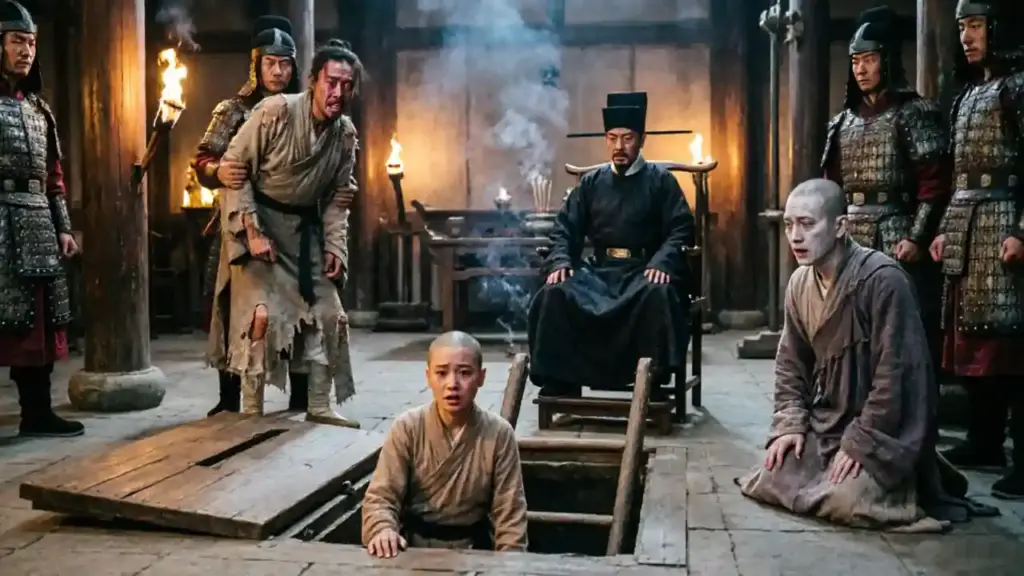
From the darkness stepped not spirits, but two living men. Iron chains clinked and snapped around the monk’s wrists.
“A ghost!” he shrieked.
“We are no ghosts, monk,” Wang Zhong said. “Lord Bao sent us.”
The voice beneath the bridge had belonged to a courtesan, hired by Lord Bao to play the part of the restless dead. The trap was perfect.
The next morning, Mingxiu confessed fully and was condemned to death.
Lord Bao then addressed Xu Xianzhong. “The monk shall pay for his crime. But you, scholar—you seduced an unmarried maiden. By law, you should be stripped of your rank. Yet consider: she died defending her chastity. Her honour is without stain. Now I offer you a choice: if you wish to marry another, you must forfeit your scholar’s robes. If you wish to preserve your rank, you must take Shuyu as your true wife in death—bury her with full rites, keep her tablet as your legal spouse, and never wed again. Which path do you take?”
Xu Xianzhong’s voice broke, but his answer was firm. “She died defending her honour. How could I bear to marry another? I will bury her as my wife. I will honour her tablet forever.”
A rare smile touched Lord Bao’s stern face. “Your heart aligns with heavenly principle. I shall protect your scholarly future.”
In time, Xu Xianzhong passed the provincial examinations. He came to thank his benefactor. “I owe you everything.”
Lord Bao regarded him with paternal affection. “Will you marry now?”
“I dare not break my vow.”
“The greatest unfilial act is to leave no heir.”
“I have chosen righteousness,” Xu said quietly. “I cannot now choose filial piety.”
Lord Bao leaned forward. “You have won your name. Lady Xiao in heaven surely rejoices. Were she alive, she herself would bid you take a concubine. Honour her as your primary wife. Then marry a second wife to carry on your line. Where is the contradiction?”
Pressed by the magistrate and a matchmaker, Xu Xianzhong took a maiden of the Huo family as a secondary consort. The marriage was solemnised modestly.
And when the official record of graduates was printed, Xu Xianzhong listed only Xiao Shuyu as his wife. The name of Huo appeared nowhere.
Thus was the wife’s chastity honoured, the husband’s fidelity kept whole. And the grace of Lord Bao—in righting the wronged, in securing the line of the faithful—rose as high as the mountains, as deep as the sea.