In the reign of a venerable Emperor, whose name now drifts upon the whispering winds of time, there lay the province of Guizhou. Within its borders, in the prefecture of Chengfan, dwelt a young scholar of great promise named Ding Rizhong. His mind was a cultivated garden, devoted entirely to the classics. To nurture his spirit in tranquility, he had taken up residence within the quiet scriptorium of the Anfu Temple.
There, amidst the scent of ancient paper and the curling tendrils of temple incense, a bond of convenience formed between him and a monk named Xinghui. The monk’s pious demeanor was a finely wrought mask, hiding a heart that would soon prove treacherous. They shared tea and simple meals, the monk’s hospitality a comforting constant for the dedicated scholar.
The Serpent in the Garden
One afternoon, while Ding was absent, Xinghui paid a visit to his home. The scholar’s wife, Deng, received him. Her beauty was as refined as a Song dynasty porcelain vase, and her speech as gentle as rippling water. Oblivious to the darkness stirring within the monk, she felt duty-bound to offer him a meal. As she moved with an unconscious grace, a dark, poisonous seed of desire took root in Xinghui’s heart. Her loveliness was a sudden, sharp pain.
Weeks later, when Ding Rizhong departed on a journey that stretched into a month, the silence of his home became the canvas for Xinghui’s sin. The monk’s plan, nurtured in the dark hours of the night, came to fruition. He paid two unscrupulous laborers, dressing them in the rough-spun robes of Taoist porters. As the sun bled crimson across the sky, they arrived at Deng’s door, their faces arranged in masks of tragic urgency.
“Madam,” one panted, his breath ragged with feigned exertion, “your husband… while deep in his books, his spirit was overtaxed. A sudden wind seized him, and he fell as if struck by a ghost. Master Xinghui revived him, but he lies deathly pale upon a sickbed, hovering between this world and the next. We have been sent to bring you to him.”
Deng’s heart, a moment before serene, became a frantic bird trapped in her ribs. “Then why not bring him home in a curtained litter?” she demanded, her voice sharp with terror.
“The journey is over ten li, Mistress,” the other porter interjected smoothly, his eyes downcast. “The night air would pierce his weakened frame. It is safer for you to come. At his side, you can decide whether he is fit to travel. Your presence would be a greater medicine than any we possess.”
Blinded by a tempest of love and fear, Deng stepped into the waiting sedan chair. The world outside faded to the rhythmic creak of bamboo and the porters’ steady footfalls as darkness enveloped the land. Yet, within the storm of her worry, a single, terrible certainty began to crystallize: they were not heading toward a sickroom.
The Feast of Shadows
They arrived at the temple long after nightfall. The chair was borne not to a guest hall, but carried directly into the deepest, most private recesses of the monks’ quarters. When the curtain was drawn, Deng saw not a physician’s basin and medicine, but a table set for a feast, its candles casting dancing, mocking shadows. A rich, cloying fragrance of wine and heady incense hung in the air.
“Where is my husband?” Deng’s voice was a blade of ice.
Xinghui emerged from the shadows, his smile a sliver of moonlight on a dark pool. “Patience, gracious lady,” he soothed. “Take some wine. Gather your strength, and I shall have them light torches to guide you.”
A cold dread, like water seeping into a tomb, began to fill Deng. She was a bird in a cage of silk and shadow. She drank a few cups of wine to still her trembling hands, its warmth a mockery of courage. As she pressed again about the porters, Xinghui’s mask grew bolder. “The night road frightens them, and they have already returned to the village,” he said with a faint, dismissive sigh. “Do not be so anxious, Madam. Drink a little more.”
At his signal, young acolytes surrounded her, their faces smooth and expressionless, their cups ever full. A strange lethargy, sweet and suffocating, began to seep into her limbs. She was soon led, her steps faltering, to a meditation chamber. But this was no ascetic’s cell. A lantern’s glow revealed embroidered quilts, a gauze curtain enveloping a vast bed, and pillows embroidered with a riot of flowers. Every object was exquisite, luxurious, and deeply, terribly wrong.
Turning, she found the walls were solid, the only door the one they’d entered, now firmly shut. She kept the lantern burning, its flame a single, defiant eye in the suffocating dark, and lay down fully clothed, her mind a taut wire, humming with dread.
When the midnight bell’s final, solemn tone had faded into the immense silence, she heard a soft scraping. A hidden panel slid open, and from the blackness beyond, a shadow took form. Xinghui rushed to the bed. “Shout until dawn cracks the sky,” he hissed, his breath hot and sour with wine. “No one will come for you here. You cannot deny it.”
“Shameless beast!” she spat. “I would die a hundred deaths before I submit to your filth.”
“Be merciful for just one night,” his voice dropped to a gruff whisper, “and I will lead you to your husband tomorrow. If you refuse me? Then I swear by the abbot’s staff, I will see your blood spilled tonight.”
Her screams tore through the hours until, near dawn, her strength was a shattered thing. He overpowered her, bound her wrists and ankles, and unleashed his brutal desire upon her.
The Bell of Silence
More than a month crawled by, each day a grey eternity, before the sound she had prayed for echoed in the temple courtyard. Ding Rizhong had come to visit his friend.
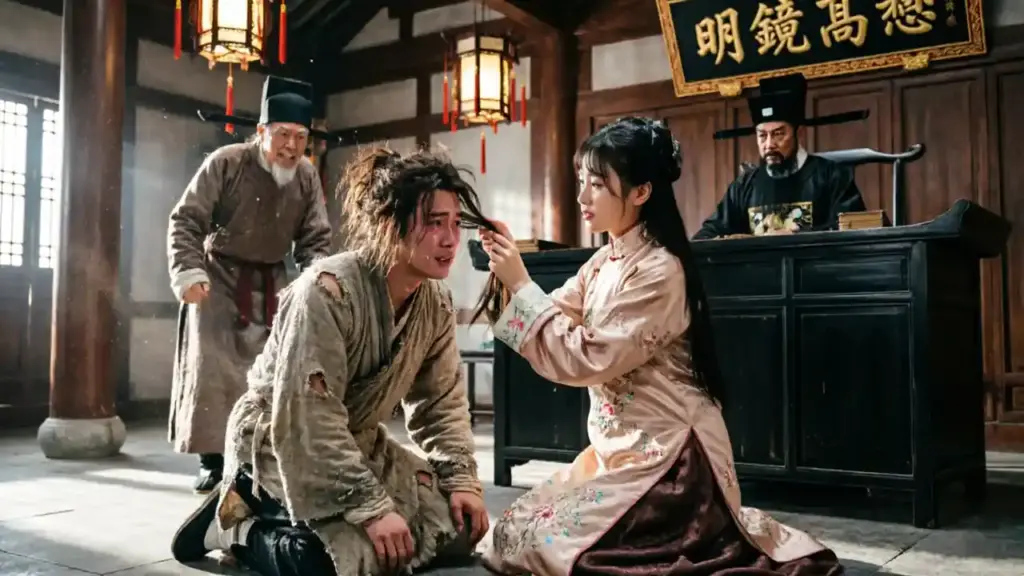
From a dim hallway, Deng saw him. The sound that ripped from her throat was not a word but a raw, unmelodious cry of a soul in torment. Her husband, seeing only a young, tonsured monk, made a polite, formal bow.
“My lord!” she wept. “Do you not know your own wife? The beast Xinghui tricked me and brought me to this hell! Day and night I have dreamt only of you saving me, and now you do not see me!”
For a heartbeat, Ding stared, his mind refusing the monstrous truth. Then, recognition and horror flooded his face. With a roar that seemed to shake the temple’s ancient beams, he lunged at the monk.
But Xinghui’s cry was a wolf’s call, and a pack of lesser monks poured into the hall. They seized Ding, tearing him from his master. A blade glinted in Xinghui’s hand as he advanced. Deng threw herself forward, baring her own neck. “His blood must flow over mine first,” she said, her voice suddenly preternaturally calm.
Xinghui lowered the knife. He had his thugs drag Deng back to her prison and lash her to a beam. Returning to Ding, his smile was a cold, terrible thing.
“You stole my wife,” Ding snarled, his eyes burning with a fire no fear could quench. “Kill me, and my ghost will gnaw at your soul through all eternity.”
“I will let you choose the manner of your passing,” Xinghui sneered. “Cover me with that great bell, and let me fade away into the next world.”
The great black weight descended, swallowing him whole. Darkness, absolute and silent, crashed down, its only companions the cold touch of bronze and the faint, mocking scent of old incense trapped within.
The Dream of Guanyin
Trapped in her room, Deng wept. Her tears were not only of grief but of a rage so profound it was a physical burning. She knelt before a small, dust-covered statue of Guanyin, the Bodhisattva of Compassion. She prayed not for her own life, but for a deliverer.
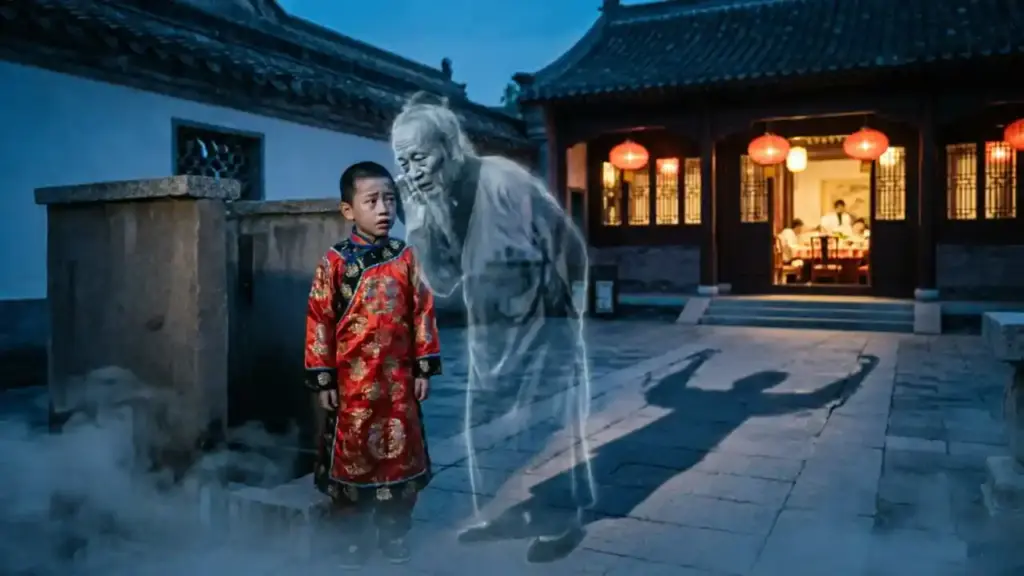
That same week, the great Lord Bao Zheng was traveling through the region. One night, a dream came to him, vivid as a painting. Guanyin appeared and pointed. The scene dissolved, and Lord Bao found himself standing before a massive, ancient bell. Beneath its rim, a great black dragon, its scales shimmering with a faint, dying light, coiled in agony, letting out a silent, suffocating roar.
The next night, the dream returned, more vivid, more urgent. On the third night, the silent roar shook him from his sleep. By dawn, his resolve was set. He descended upon the Anfu Temple.
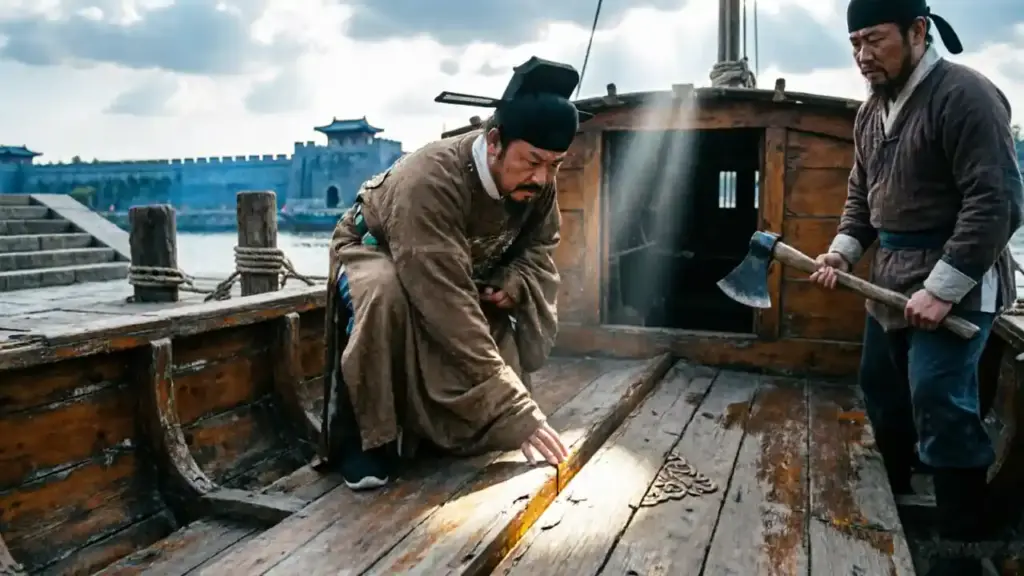
Lord Bao strode into the abbot’s quarters. “There is a bell here,” he stated, his voice like the crack of a stone tablet. “Raise it.”
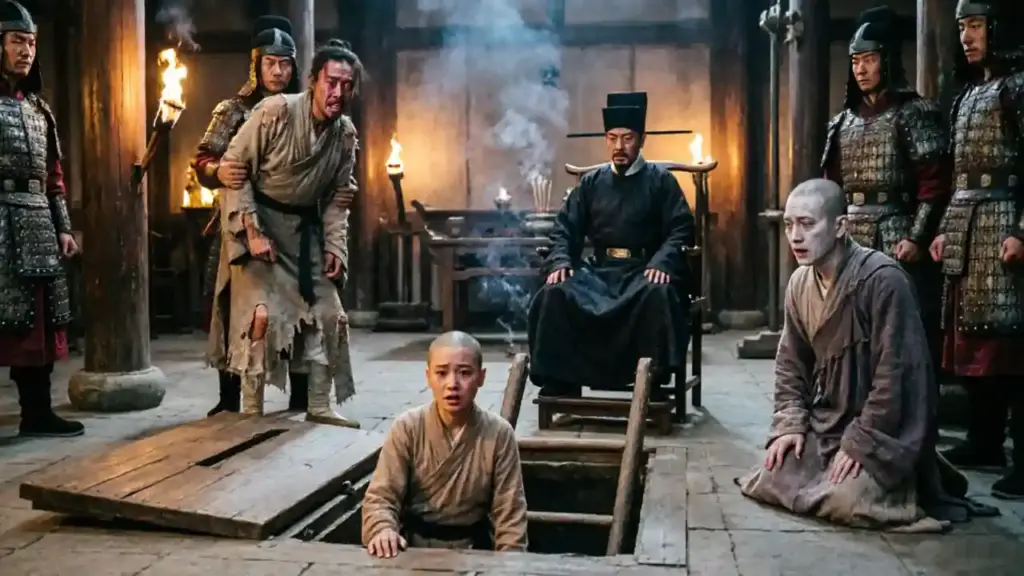
With a great heave, the soldiers lifted the bronze giant. A collective gasp of horror rippled through the hall. A figure, skeletal and ashen, lay motionless on the cold stone. Life, by the thinnest of threads, still clung to the body.
Ding Rizhong opened his eyes to the world of light, and the first face he saw was that of the legendary Lord Bao. “Xinghui… the monk… stole my wife… made her a monk… trapped me… here to die.”
Lord Bao’s order was swift. Xinghui was dragged forth, his mask of piety shattered into a rictus of pure terror. A search revealed the hidden pit, and Deng emerged, blinking in the sudden light.
The story poured forth in a torrent of anguish. Xinghui, pinned by her truth, could do nothing but whimper.
The Judgment
Lord Bao’s verdict was delivered in a voice that held the weight of mountains. “The beast Xinghui… repaid friendship with treachery… His sentence is clear: public execution by beheading. The monks who aided him… shall have their heads marked with the brand of criminals and be exiled.”
He turned to Deng, his voice softening. “Woman, when you were tricked that first night, a swift death would have been the celebrated path of a martyr.”
Deng’s tears fell with a different, more solemn rhythm. “Lord Judge, the thought of death was a constant companion. But to die then would have been to swallow an unrevealed wrong forever. I chose the hell of life so I might one day show my husband the face of his destroyer.”
Her voice dropped to a mere whisper. “I am a soiled thing… There is only one path left to prove my heart.”
Before anyone could move, she wrenched herself free and flung herself headlong at an iron-sheathed pillar. The sound of the impact was a dull, sickening thud. She crumpled to the ground, a bright, terrible river of crimson spreading across the stone floor.
Lord Bao was stilled by the shocking act of final virtue. The physician worked, and for a long, breath-held time, the hall stood in silence. The injury was grievous, but the will of heaven was not for her to perish.
Ding Rizhong knelt before his wife. The suspicion, the cold seed of doubt, was washed away by the torrent of her crimson sacrifice. “Once,” he said, his voice breaking, “I was a fool who thought her survival an act of cowardice. Now I see it was the bravest act of love. We will begin again.”
And so, husband and wife, forged anew in the crucible of unimaginable suffering, bowed in gratitude to the lord who was heaven’s own instrument. They returned home, and in their courtyard, they erected a shrine to Lord Bao, offering incense morning and night.
In time, under the compassionate gaze of Guanyin, the shadows of the past receded. Ding Rizhong’s mind, once clouded by despair, grew sharp and bright once more. He rose to high honors in the imperial examinations, a living testament to the truth that a love forged in sorrow and sealed by sacrifice can, against all darkness, endure.