In the county of Dinghai, under the vast jurisdiction of Ningbo Prefecture, two men stood bound by the twin ties of shared soil and shared service. One was Gao Ke, a man of rank who held the office of Assistant Commissioner; the other was Xia Zheng, a Vice Minister who served the imperial court with distinction. Their lives in the capital were so thoroughly intertwined that visits between their households felt as inevitable and natural as the turning of the seasons. Fortune, in a moment of whimsical synchrony, smiled upon them both: their wives found themselves with child at nearly the same time. Buoyed by the expansive joy of impending fatherhood, the two friends sealed a pact with laughter and lifted cups—if one family were blessed with a son and the other with a daughter, the children would one day be joined in marriage.
In due course, the Xia household welcomed a boy they named Changshi, while the Gao family was blessed with a daughter, Jiyu. Without delay, Vice Minister Xia dispatched a matchmaker to the Gao residence, bearing a formal proposal and a pair of gold hairpins as tokens of the pledge. Commissioner Gao accepted with hearty goodwill, returning a pair of jade hairpins—an exchange that felt heavy with promise, as though the very objects understood the gravity of the bond they were meant to seal.
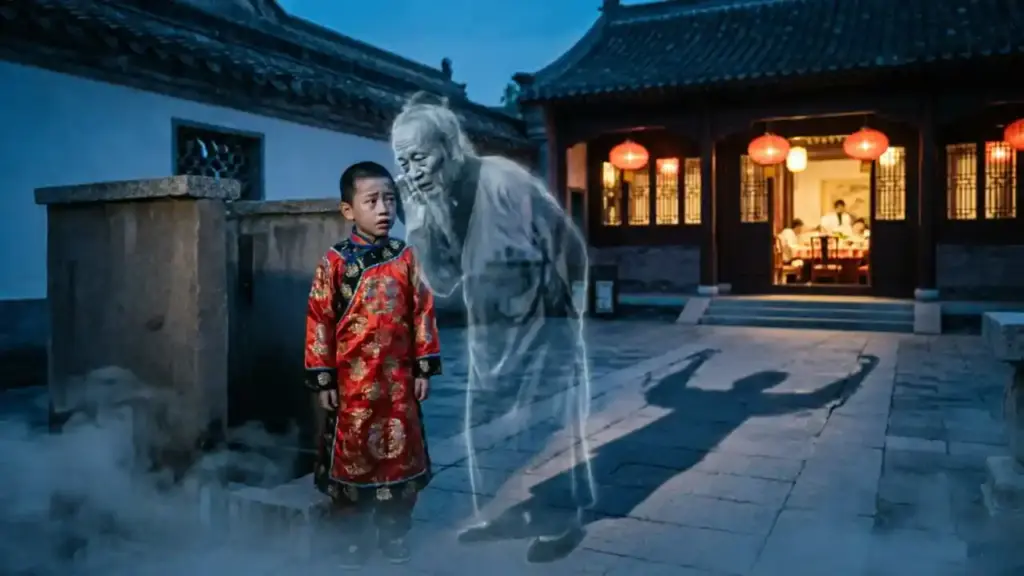
But fate, as it so often does, unfolded along paths no one could have foreseen. Vice Minister Xia was a man of unblemished integrity, the rare sort of official whose hands remained stubbornly empty in a world that richly rewarded the grasping. When death claimed him in the capital, his family discovered the true cost of his principles: there was not enough silver to send his coffin home. It fell to Gao Ke, moved by the memory of their old friendship, to shoulder the expenses and arrange for the casket’s solemn journey back to their native soil.
Not long afterward, Gao Ke himself retired and returned to his hometown. His years of service, unlike Xia Zheng’s, had yielded a fortune that, by even conservative estimates, numbered in the tens of thousands of taels.
Xia Changshi, meanwhile, had grown into a young man of considerable scholarly promise. By sixteen, he had placed first in the prefectural examinations and earned the title of licentiate. Yet his learning could not fill an empty bowl. Poverty clung to him with the tenacity of damp to a northern wall; each meal was a grim calculation, each day a small, exhausting triumph of survival over despair. Swallowing what remained of his pride, he sent an intermediary to the Gao household, hoping to settle the marriage and bring his intended bride home.
But Gao Ke’s heart had soured with the passage of time and the weight of his own prosperity. The prospect of a poor son-in-law was a bitter draught he had no intention of swallowing. He set an impossible condition, his voice carrying the careful, practiced edge of a man who has already decided the outcome: “If he wants a wedding, let him present the full six betrothal gifts. I will not hand over my daughter for empty words. And if he cannot manage it, he would do better to withdraw his suit entirely. I am prepared to offer him a generous sum—enough to find a wife elsewhere.”
Three years slipped past in this agonizing impasse, each season filing away at hope until it wore as thin as old silk.
Jiyu was no longer a child. She had grown into a young woman of quiet perception, and what she perceived of her father’s maneuvering filled her with a steady, private sorrow. Time and again, she pleaded with her parents not to betray the promise made before her birth; time and again, her father’s face hardened into the same implacable mask. “If the boy can produce a hundred taels of betrothal silver,” he would say, each word measured and final, “you may marry him if you wish. If he cannot, let the matter rest.”
Desperation and love have a way of sharpening a young woman’s courage. Jiyu, her heart pounding with a volatile mix of fear and resolution, slipped into her father’s study and removed a portion of silver. To this she added her own treasures—bracelets, hairpins, a set of jeweled ornaments, a gilded powder box—everything she had gathered since girlhood. Each piece was a memory, now reduced to mere commodity. Together, she calculated, they would exceed a hundred taels in value.
She summoned her personal maid, Qiuxiang, a girl who had served her long enough to be trusted with something far weightier than household tasks. “Go to Master Xia,” Jiyu instructed, her voice low and urgent. “Tell him this: The young lady sends her respects. Her father wishes to break the engagement, but she has fought him at every turn and refuses to yield. He has finally relented enough to say that if the young master can present a hundred taels in betrothal gifts, the marriage will proceed. The silver and ornaments are ready—they total more than enough. Let him come to the back garden tomorrow night to receive them. He must not miss the hour.”
When the message reached Xia Changshi, joy erupted within him like a spring flood shattering a dam. He had one confidant above all others—a man named Li Shanfu—with whom he shared the intimate geography of his heart, every hope and every fear. In the first, breathless flush of his elation, he poured out the entire story, sparing not a single precious detail.
Li Shanfu listened in silence. But behind his attentive gaze, something dark and glacial began to stir. A scheme, venomous and complete, assembled itself in the quiet span between heartbeats. He clapped Changshi on the shoulder, a warm smile stretching across his face. “Such fine fortune deserves a celebration, brother. Allow me to bring a jar of wine to mark the occasion.”
When the appointed night arrived, Li Shanfu came as promised, the wine jar cradled in his arms. The two friends sat facing one another and drank. But the wine had been doctored; a colorless, insidious drug swirled unseen beneath its amber surface. Changshi had barely drained a few cups when the world began to spin and tilt on its axis. His head dropped, consciousness fleeing like a candle flame pinched between wet fingers.
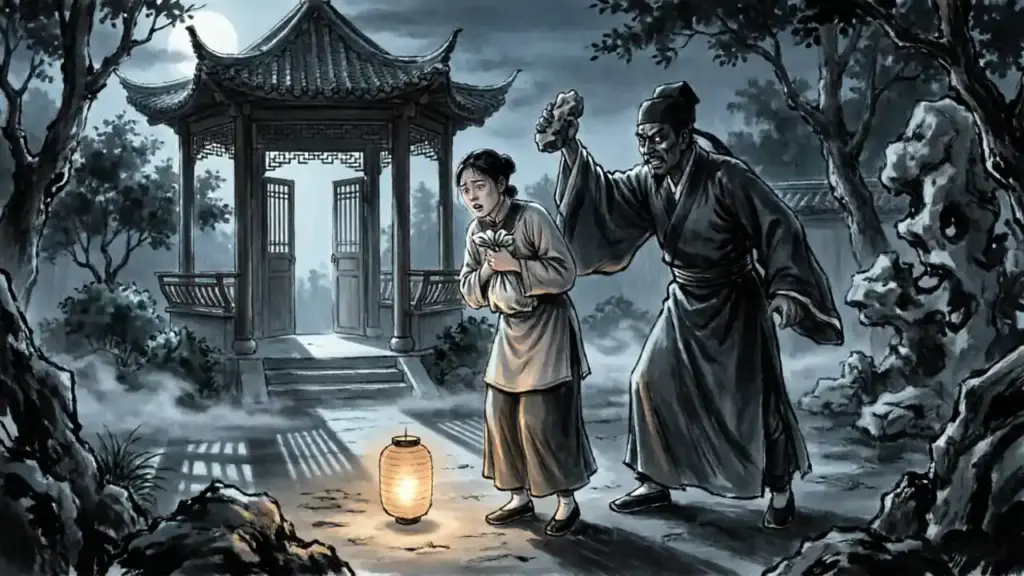
Li Shanfu did not hesitate. The moment he saw his friend crumple into insensibility, he slipped out into the night and made straight for the Gao family’s back garden. The gate stood slightly ajar, just as promised, and he eased through it into the swallowing darkness. Groping his way toward the pavilion, he made out a solitary figure—a serving girl clutching a cloth-wrapped bundle, her posture rigid with anxious waiting.
“The silver—give it here,” he said, reaching out a hand.
Qiuxiang lifted her lantern. In the wash of its pale, trembling light, she studied the face before her. Her expression shifted, a flicker of alarm crossing her features. “You are not Master Xia.”
“Of course I am. Qiuxiang, was it not you who arranged this meeting?”
She peered at him again, and this time the alarm solidified into cold certainty. “You are not him at all. You are a thief!”
Something savage uncoiled in Li Shanfu’s chest. He bent, his fingers closing around a loose stone from the garden path, and brought it crashing down against Qiuxiang’s skull. The sound was wet and final. She crumpled without a cry, blood welling darkly from her temple and spreading in a slow, terrible tide across the flagstones. He tore the bundle from her unresisting hands and fled back the way he had come.
Changshi still lay where he had fallen, utterly insensible. Li Shanfu settled himself nearby and feigned the heavy, slack-limbed sleep of deep intoxication.
A long while later, Changshi stirred. Consciousness returned in jagged fragments—a dull, throbbing ache behind his eyes, the sour, metallic taste of something wrong at the back of his throat. He shook his head groggily and nudged his friend. “Shanfu, I was supposed to go tonight. I must fetch something.”
Li Shanfu made a show of blinking awake, rubbing his eyes with theatrical slowness. “Ah, brother, you truly cannot hold your wine. I waited for you to rouse and must have drifted off myself. The hour is late now—you had best hurry.”
Changshi hurried. But when he reached the Gao family’s back garden, the silence that greeted him was heavy and absolute, as though the very night held its breath. He found Qiuxiang sprawled near the pavilion and, thinking she had simply succumbed to weariness, bent to help her up. His hand brushed against skin that was already cooling. He called her name. No response. He leaned closer, and what he saw—the matted hair, the dark, glistening stain, the terrible stillness—sent horror flooding through him like ice water. The bundle was gone. He fled home, heart hammering against his ribs, the image of her shattered head burning behind his eyes.
By morning, the Gao household had discovered Qiuxiang’s absence and, after a frantic search, her body. Consternation rippled through the compound like a shockwave.
Jiyu understood that the truth, however damning, could no longer be hidden. She came forward, her eyes rimmed with weeping, and spoke. “I sent Qiuxiang on an errand of my own devising. She was to deliver silver and ornaments to Xia Changshi so that he might prepare the betrothal gifts and marry me. I did not imagine this man could be so utterly heartless as to kill her. It seems he never wished to marry me at all.”
Commissioner Gao’s rage broke like a thunderclap. He dispatched his servants to the prefectural court with a formal complaint, accusing Xia Changshi of murder for gain.
Changshi, for his part, submitted a counter-suit proclaiming his innocence.
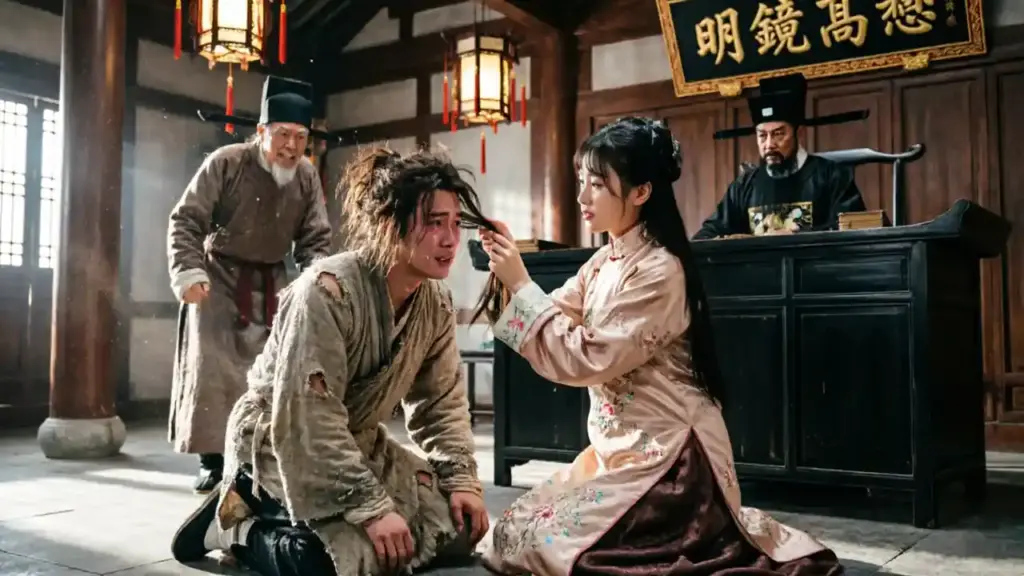
The case came before Prefect Gu, who summoned both parties to his tribunal. The hearing yielded only contradiction and confusion, charges and denials circling each other like wary dogs in a pit. Prefect Gu then called Jiyu to testify. Kneeling before the dais, she recounted the sequence of events in a voice that wavered but did not break. She had ordered Qiuxiang to deliver the valuables, yes; but how the maid had met her death, she could not say.
Changshi, his eyes rimmed with red, spoke from a place beyond hope. “What Jiyu has said of the earlier events—every word is true. If I must die, I will bear it without resentment. But to say I took the silver and then bludgeoned Qiuxiang to death? I would go to my grave refusing to accept that. Yet here I stand, with no way to prove my innocence. Perhaps this is a debt from a former life that I must repay in this one.”
To the astonishment of all who heard, he accepted the charge.
Prefect Gu issued his ruling: Xia Changshi, in a frenzy of greed, had slain a serving maid and stolen her valuables—a crime for which no punishment short of death would suffice. He was condemned to await execution. Gao Jiyu was to be married elsewhere. Thus the case was closed.
For three years, Xia Changshi languished in the death-row cells, marking time in the perpetual twilight of the condemned.
And then Lord Bao, the imperial censor, arrived on his circuit of inspection. His renown preceded him—the Dragon Image Scholar, the incorruptible judge who could tease truth from the most tangled skein of deceit. He entered Zhejiang Province traveling incognito, in the plain robes of a commoner, and eventually made his way to the county seat of Dinghai. Magistrate Hu, failing to recognize the man before him and suspecting only an idle interloper seeking to curry bureaucratic favor, had him thrown into the jail.
Lord Bao accepted this turn of events with unruffled composure. He passed his days among the prisoners, listening. “I have some skill with legal documents,” he told them conversationally. “If any of you carries an unredressed grievance, tell me your story. I will draft a petition on your behalf.”
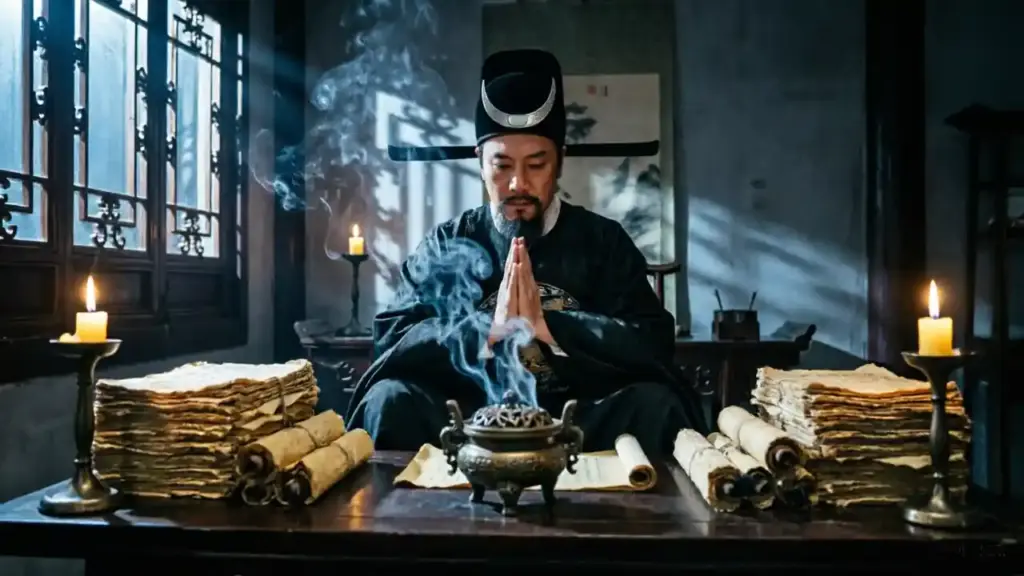
Xia Changshi, hearing this, unburdened himself of every particular of his case. Lord Bao listened, committing each detail to memory with the precision of a master calligrapher inscribing text upon silk.
When the moment was right, Lord Bao revealed his identity. Magistrate Hu, his face draining of all color, knelt and begged forgiveness for his spectacular misjudgment. Lord Bao waved the matter aside as one might brush away a gnat and immediately ordered the files of Xia Changshi’s case brought before him.
He summoned Jiyu and questioned her anew. Her account remained unchanged: she had dispatched Qiuxiang with the valuables, but the killer could only have been Xia Changshi. No other explanation was conceivable.
Lord Bao considered her words. Then he turned to Changshi. “When you first learned of the arrangement, did you share the information with anyone?”
“Only my closest friend,” Changshi replied. “Li Shanfu. That same night, I drank wine at his house and lost consciousness. When I awoke, he was sitting beside me. He had not stirred.”
A small, knowing light kindled behind Lord Bao’s eyes. He asked no further questions about the case. Instead, he announced an examination for the licentiates of Ningbo Prefecture.
Li Shanfu achieved the highest mark. Lord Bao singled him out for particular favor, summoning him frequently for private conferences, addressing him with the warmth of a teacher toward a prized disciple. This intimacy continued for nearly half a year.
One day, Lord Bao sighed with practiced weariness. “I have spent my career in honest service, and poverty has been my only companion. Now my daughter is to be married, and I cannot even assemble a proper trousseau. Keep your eyes open for me when you are abroad. If you encounter fine goldwork—pieces suitable for a bride—help me acquire them. Should you ever need my assistance in the future, I will remember your kindness. You are my most promising student. Only, I beg you, keep this matter entirely confidential.”
Li Shanfu, thoroughly deceived by the performance, did not hesitate. Within days, he presented Lord Bao with a pair of antique gold hairpins, a pair of jade ornaments, a gilded powder box, and a gold mirror-case—each piece exquisite, each unmistakably distinctive.
Lord Bao received them with a show of transports of delight.
Shortly thereafter, he reconvened the tribunal. Xia Changshi was brought from his cell. Jiyu was summoned. The principals in the old case assembled once more.
Lord Bao commanded that the gold hairpins, the jade ornaments, the powder box, and the mirror-case be arrayed upon a table before the court. He turned to Jiyu. “Do you recognize these?”
The color drained from her face. Her hand rose to her lips, and tears spilled down her cheeks. “Every piece,” she whispered. “These are all the things I sent to Xia Changshi that night.”
Lord Bao gave a nearly imperceptible nod and ordered Li Shanfu brought forward.
When Li Shanfu stepped into the hall and saw Jiyu standing over the table of ornaments, his face underwent a terrible transformation—the blood fled from it, leaving behind the gray pallor of old ash. His legs threatened to buckle beneath him. Stammering, he claimed to have obtained the items from a traveling merchant whose name he could not recall.
Xia Changshi, watching, felt the scales fall from his eyes. Understanding crashed over him in successive waves: the drugged wine, the feigned sleep, the friend he had trusted with his dearest hopes. A sound tore from his throat—half sob, half howl. “Friend! Such a friend you have been! You have destroyed me!”
Li Shanfu’s defenses crumbled to dust. Before that array of glittering, damning objects, he confessed to everything, the words spilling from him like poison drawn from a wound.
Lord Bao took up his brush and composed the verdict with swift, decisive strokes:
Li Shanfu, driven by avarice and stripped of every human decency, drugged his friend’s wine to facilitate a murderous ambush. He bludgeoned an innocent serving maid to death and made off with the treasures she guarded. The gold hairpins and precious ornaments, recovered as irrefutable evidence, testify against him. For the life he has taken, let his own life be forfeit. The penalty is death, and no mitigation shall be entertained.
Gao Ke, who scorned poverty and sought to break a solemn covenant, nearly consigned his own son-in-law to a wrongful grave. In consideration of his rank among the gentry, let his punishment be tempered—but let his conscience serve as his unsparing judge.
Xia Changshi has languished in chains for a crime he did not commit. Let him walk free from this hall, his name cleared and his honor restored. Gao Jiyu, who held fast to her vow when all the world conspired to loosen her grip, has proven her fidelity beyond any measure. Let them be joined as husband and wife, as was promised before their birth.
Thus was Xia Changshi delivered from the shadow of death into sudden, dazzling light—acquitted, vindicated, and wed to a woman whose constancy had been tested in the crucible of despair and emerged pure gold. Their union was one of profound devotion, the kind that is forged rather than found. They commissioned a portrait of Lord Bao and enshrined it in their home, offering incense before it each morning and evening with the reverence due a savior.
In time, Xia Changshi applied himself to his studies with a ferocity born of borrowed years. He passed the metropolitan examinations with distinction, rose through the ranks of officialdom, and ultimately served with honor as a Supervising Secretary—a testament to the truth that even the darkest chapters may yield, in their fullness of time, to a brighter turn of the page.