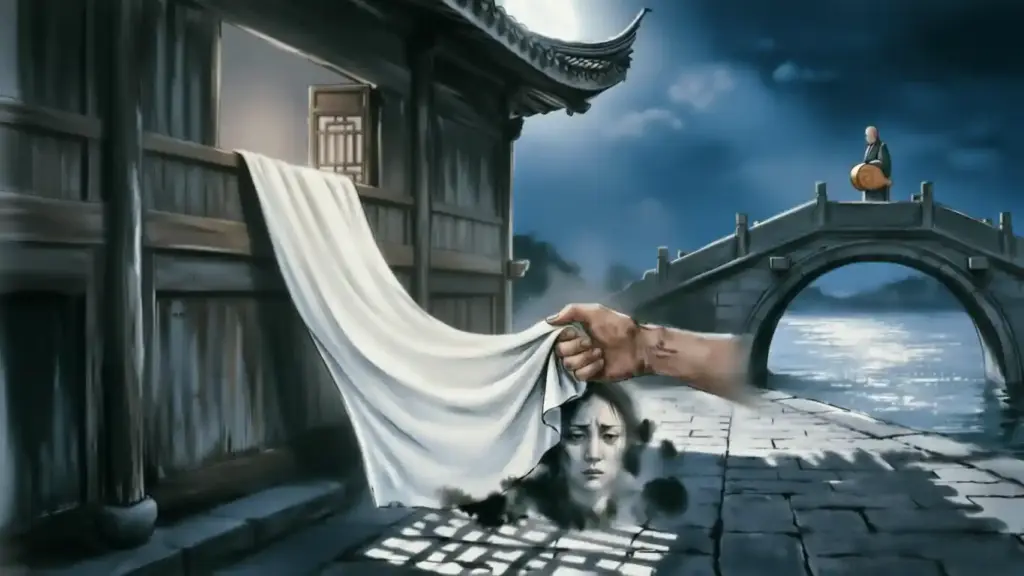
Five li beyond the Western Capital’s gates, where the paved road surrenders to the gentle sprawl of farmland and mulberry groves, stood the Shi family estate. It was a compound of weathered blue brick and grey-tiled roofs, its front courtyard open and unassuming, like a man with no secrets to keep. Within these walls, two brothers had come of age, each bearing a distinct measure of pride. The elder was Shi Guanshou; the younger, Shi Madu. Both were men of stubborn ambition, yet the younger had long since departed for the south, carving out a livelihood in Yangzhou as a master weaver of figured brocades. The elder remained, having taken a wife named Liu Dusai. Her beauty was the quiet, reverent whisper of the surrounding countryside—a face rendered with a painter’s most delicate brushstroke, a figure that moved with the liquid grace of willow fronds in a spring breeze. Together they had a son, Jinbao, a boy of five winters so exquisitely formed and bright-eyed that strangers in the marketplace would halt just to smile at him.
That year, on the fifteenth day of the first lunar month, the Festival of Shangyuan descended upon the Western Capital. It was the one night the city shed its skin, forgetting itself in a riot of light and clamor. Lady Liu sought her mother-in-law’s permission early, and upon receiving it, retreated to her chamber to prepare. Before her polished bronze mirror, she applied the faintest dusting of powder, swept her dark hair high, and secured it with a hairpin of clustered pearls that trembled with her every movement. She chose a robe of woven gold and kingfisher blue; when she finally stepped back, the woman in the reflection seemed to have stepped straight from a silk scroll. With her maid, Meixiang, and the old family steward, Uncle Zhang, she set off toward the city, their laughter spilling onto the road ahead.
By the time they arrived, the streets had transformed into a living, breathing tide. Lanterns blazed from every eave, but it was the great lantern mountain before the Turtle Mountain Temple that stole the breath from the crowd—a three-story pyramid of flame and colored paper casting its glow halfway to the stars. The crowd surged in rhythmic waves, and Lady Liu, face tilted upward in wonder, allowed herself to be swept along. When she finally lowered her gaze, Meixiang and Uncle Zhang had vanished. Strange faces pressed in from every side; the roar of the throng filled her ears like rising water. A cold, thin thread of fear tightened around her heart.
Then, the wind struck.
It tore down from nowhere, a freak gust whipping dust and grit into the air, cutting through silk like a winter blade. It slammed into the great lantern at the mountain’s peak with a sound like snapping bone. The frame splintered, and the vast, blazing sphere plunged downward, smashing into the earth in a violent spray of fire. The crowd shattered into chaos—screaming, running, trampling. Lady Liu was flung this way and that, stumbling, nearly falling, until she finally collided with a wall in a deserted side street. Distant lantern-light flickered; here, there was only darkness, and a silence that pressed heavily against her ears. She did not know this quarter. She did not know the way home. The cold crept from her feet to her throat, and she was on the verge of tears when she heard it: the rhythmic beat of boots on stone, the clatter of hooves, the deep, commanding shouts of an official procession clearing the way.
A column of armed riders emerged from the gloom, torches and lanterns trailing behind them like a river of fire. At their head, atop a tall horse draped in silk and brass, sat a man in a brocade robe and a jade belt—Zhao Wang, a Prince of the imperial blood. His eyes swept the street and found her: alone in the half-light, her frightened face made luminous by the distant glow, rendered even more beautiful by her distress. Something stirred in his chest. He reined in his horse and dismounted.
He walked toward her slowly, his gaze traveling over her, a smile creeping to the corners of his mouth. “Whose wife are you?” he asked. “And what keeps you out at such an hour, alone?”
Lady Liu’s heart hammered against her ribs, but her wits did not desert her. “This humble woman is from the Eastern Capital,” she said, forcing her voice to remain steady. “I came with my husband to see the lanterns. When the lamp mountain collapsed, we were separated in the crowd. He has not returned, and I have been waiting here.”
The Prince’s smile deepened. His tone was gentle, almost kindly, but beneath it lay an undercurrent that brooked no refusal. “The night is too deep for a woman to stand in the street. Come to my residence and rest until morning. Tomorrow, I will have men search for your husband.”
She opened her mouth to refuse, but her eyes met the gleaming spear-points and the hard, impassive faces of the soldiers. The words died in her throat. She bit her lip, knowing in her bones that there was no escape, and lowered her head in silent assent.
Inside the Prince’s mansion, serving women led her to a chamber of suffocating opulence. A gold, beast-shaped censer breathed threads of aloeswood smoke into the air. Gauze curtains hung in layered cascades, and everywhere she looked, pearls, jade, and gilded carvings caught the lamplight. She sat on the edge of a cushioned couch, too unsettled to truly see her surroundings, until footsteps sounded behind her. The Prince had changed into informal robes. He stood in the doorway with the easy, terrifying confidence of a man who has never been denied.
“I am of the imperial blood,” he said, “a branch of gold and a leaf of jade. If you consent to be my consort, a lifetime of wealth and honor awaits you, beyond anything you have ever known.”
She felt the words like a physical blow. Her head rang. She lowered her face, her whole body beginning to tremble, lips moving soundlessly. She wanted to die—but the beams of that luxurious room were wrapped in embroidered silk, every corner cushioned. There was nothing, absolutely nothing, to throw herself against. The Prince’s power pressed down on her like a wall of stone. What could she do, a woman alone? That night she was kept in the mansion; her tears soaked through the embroidered pillow, but she did not dare sob aloud.
The next morning, the Prince gave a feast, his face glowing with satisfaction, as if a great blessing had descended upon his house. But in the Shi family home, the world had already begun to crack apart. Uncle Zhang and Meixiang, having searched the lantern-lit streets until their voices were hoarse, stumbled back to the estate with the news that the young mistress was gone. The old mother and Shi Guanshou went nearly mad with panic. That very night, they sent every servant into the city. Days of searching yielded only a whisper: someone had seen a woman matching Lady Liu’s description being led into the Prince’s mansion. But the Prince’s mansion was a fortress—high walls, deep courtyards, guards in armored ranks. Ordinary folk could not even approach the gate. Shi Guanshou could neither eat nor sleep. He beat his chest, paced the halls, and stared at the road, but nothing he did could bring her back.
A month passed within the mansion. Lady Liu wore silk and ate from jade dishes, but her face grew pinched, her eyes hollow. She thought of her mother-in-law, of her husband, of little Jinbao—five years old and waiting for a mother who would not come home. The ache in her chest never loosened its grip. By day, she forced herself to smile; at night, she sat alone before a solitary lamp, weeping silently as the flesh melted from her bones.
Then, one day, a trivial accident set the wheel of fate turning. Mice had found their way into her chamber and torn her favorite robe—the “Woven Myriad Images” brocade—to shreds. She gathered the fragments, tracing with trembling fingers the ruined pattern of trailing lotuses that the Shi family had woven for generations, and a fresh wave of grief broke over her. Her brow furrowed, and her face settled into lines of deep, unyielding melancholy.
The Prince found her like that and asked what troubled her. She told him about the robe. He threw back his head and laughed, a sound that bounced hollowly off the silk-wrapped walls. “Nothing could be simpler,” he said. “I will issue a notice summoning the finest weavers in the Western Capital to weave you an exact replacement.”
The notice was posted, and a man came to answer it. The Shi family’s hereditary craft was unique in the capital. Shi Guanshou had been frantic with the impossibility of discovering his wife’s whereabouts; the moment he saw that notice, a spark of desperate hope flared in his chest. He took leave of his mother, who wept and made him promise again and again to be careful, and presented himself at the Prince’s mansion.
The Prince glanced at him, noted his respectable bearing and composed speech, and saw no reason for suspicion. “Since you have the skill,” he said indifferently, “set up your loom in the eastern corridor and weave it to match the original.” Shi Guanshou bowed his head and was led away. Five looms had been placed there already, and five craftsmen were at work.
The serving-women were incurable gossips, and word soon reached the inner apartments: the Prince had summoned five weavers to the eastern corridor. Lady Liu felt her heart lurch. In the entire Western Capital, only the Shi family knew the secret of weaving the Myriad Images brocade. The younger brother, Madu, was far away in Yangzhou and had not returned. Then who…? She could not let herself complete the thought, but her blood was already racing. She made an excuse about wanting to inspect the weaving and hurried to the eastern corridor.
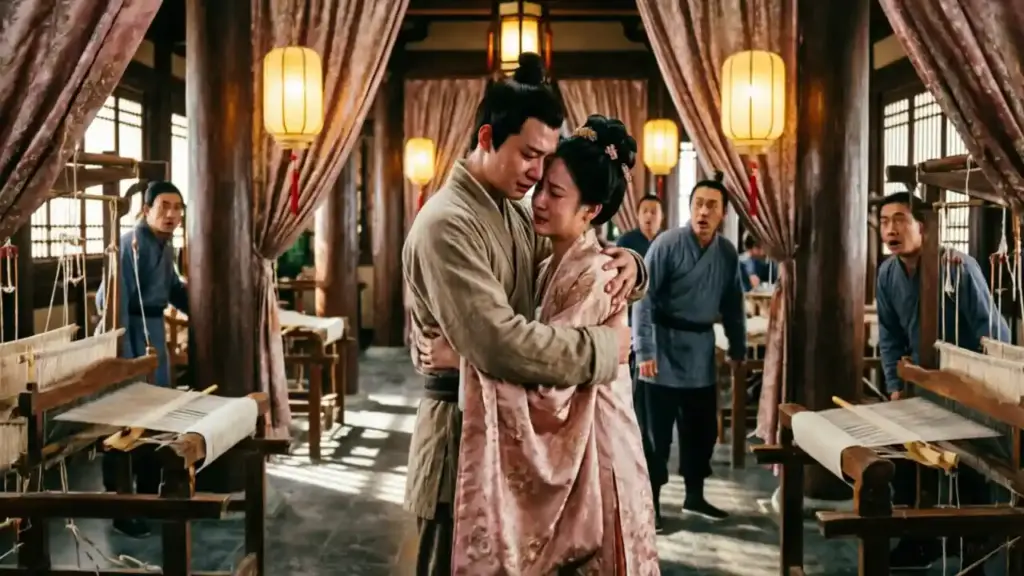
She heard the clatter of the looms before she saw them. And then she saw him—the familiar line of his shoulders, the slight dip of his head, the rhythm of his hands throwing the shuttle. Every detail of him was carved into her memory. She stumbled forward. He looked up. Their eyes met.
For one suspended moment, time stopped.
Then a choked cry broke from her throat, and she flew into his arms. He dropped the shuttle and caught her, holding her so tightly it seemed he would press her into his very bones. There in the corridor, before the stunned eyes of the other weavers, they clung to each other and wept with the abandon of the utterly broken, their hot tears mingling and soaking each other’s collars. The four craftsmen stared, frozen at their looms, exchanging bewildered glances.
And in that moment, the Prince’s shadow fell across them. He had drunk too much at his banquet, woken to find Lady Liu gone, and followed the maids’ directions to the eastern corridor. The scene he found there—his new consort locked in the arms of a common weaver, sobbing as though her heart would tear apart—sent a sheet of red rage through his skull. His eyes blazed. “Seize them!” he roared. “All five of those insolent dogs—drag them to the execution ground and finish them this instant!”
No plea was heard, no word of defense spoken. The executioners fell upon Shi Guanshou and the four innocent craftsmen and hauled them away. A flash of steel. Five heads thudded into the dust of the execution ground, and the hot blood spread in dark pools that soaked into the yellow earth.
The Prince’s rage did not cool; it curdled into something far colder and more calculated. He sat in his hall, and the thought crept into his mind: I have killed her husband. The Shi family will never let this rest. The cruel logic of power led him inexorably onward. He dispatched five hundred soldiers. That night, under a sky lit by torches and the glitter of drawn blades, they surrounded the Shi family compound. The gate splintered under their assault. They cut down every soul inside, man and woman, old and young, and the screams rose into the darkness and then stopped. Blood ran from the threshold in dark, meandering rivulets. When the killing was done, the soldiers stripped the house of everything of value, and then they threw the torches. The flames leapt up, roaring, painting half the sky crimson, and by the time the sun rose there was nothing left but blackened timbers and ash.
Only two people escaped the slaughter that night: the old steward Uncle Zhang, and the young master Jinbao. Zhang had taken the boy out to buy sweet cakes in the street market because the child had been crying for his mother and could not be consoled. When the old man and the little one came back hand in hand, they found the bodies sprawled in the blood-wet courtyard, the air so thick with the stench of death that it choked the breath. The house was still burning. Zhang stood as if struck by lightning, the cakes dropping from his hand and shattering on the ground. His voice shaking, he asked the neighbors what had happened. White-faced, stammering, they told him.
When they finished, the old man’s face was a mask of tears. He looked down at the silent, terrified child clutching his leg, and something hardened inside him. He took a breath, bent down, and gathered the five-year-old boy into his arms. Without stopping to pack so much as a change of clothes, he turned his back on the ruin and fled into the night, heading for Yangzhou, heading for the Second Master, Shi Madu.
The Prince, back in his mansion, allowed himself a moment of satisfaction. But a thought nagged at him: the younger brother was still in Yangzhou. If word reached him, he could travel to the capital and appeal to the throne. That was a risk the Prince would not tolerate. He wrote a letter immediately and sent it by trusted courier to the Eastern Capital, to an official named Sun Wenyi, who served as Supervisor of the prison bureau. Sun Wenyi owed his entire career to the Prince; he opened the letter, read its contents, and without a flicker of hesitation dispatched his constables to Yangzhou to arrest Shi Madu.
That same night in Yangzhou, Shi Madu slept badly. In his dreams he saw his family, their bodies streaming blood, their faces blurred and strange, reaching out to him with desperate hands and crying words he could not hear. He woke in a cold sweat, his heart slamming against his ribs. When morning came, his unease only deepened. He went to a diviner and asked for a reading. The old man studied the stalks and the hexagram and his face fell. A great calamity, he said. A whole family brought to ruin. Shi Madu felt invisible fingers closing around his throat. He could no longer sit still. He hired a fast horse, took leave of his employer, and rode day and night toward the Western Capital.
At a place called Maling Village, as dusk was gathering, he saw two figures stumbling along the road ahead: a stooped old man, and a small child in his arms. Drawing closer, he recognized Uncle Zhang—and the child, he saw with a shock that hollowed out his chest, was his own nephew Jinbao. Zhang saw him, and it was as if a drowning man had caught hold of a floating spar. The old steward dropped to his knees in the road and wept aloud, and in a broken voice told Shi Madu everything.
Shi Madu listened. The world tilted, turned black, and he pitched off his horse and hit the ground unconscious. Zhang frantically pinched the pressure point above his lip, poured water into his mouth, and after a long while Madu’s eyes flickered open—blood-red, animal eyes—and a sound came out of his throat that was not a human cry. He ground his teeth until he tasted iron, wiped his face, and without another word set out for the Eastern Capital with the old man and the child in tow. He was going to beat the grievance drum at the gate of Kaifeng Prefecture, at the hall of the great Lord Bao himself.
But fate, which had been cruel, was not yet done with the Shi family.
Before they could reach the prefectural hall, they crossed paths with Sun Wenyi’s procession. The Supervisor’s guards cleared the way with harsh shouts, and among the constables were men who recognized Shi Madu’s face. They murmured the news to their master. Sun Wenyi’s expression hardened. If it weren’t for the Prince’s letter, he thought, this wretch would have slipped through. Without even raising his eyes, he casually charged Shi Madu with the offense of “obstructing an official procession” and had him dragged into the yamen. Shi Madu never got a single word of his accusation past his lips. The cudgels fell in a furious rain, and when they stopped, he lay dead on the flagstones.
Sun Wenyi ordered his men to search the body. From the dead man’s inner garment they pulled out a formal plaint, written in characters that seemed to bleed with grief—a meticulous account of every crime the Prince had committed. Sun Wenyi read it, and a cold breath escaped him. Too close, he thought. And then a darker thought followed. He summoned four trusted constables and gave them their orders. They stuffed the body into a great bamboo basket, covered it under a thick layer of yellow vegetable leaves, and waited for nightfall. Under cover of darkness, they were to carry it out of the city and sink it in the river.
But fate, for all its cruelty, was not yet finished with the Shi family—and perhaps, in ways invisible to mortal eyes, it was not entirely without mercy.
The four constables were making their way through the West Gate Quarter when they rounded a corner and found themselves face to face with the sedan chair of none other than Lord Bao. The great judge was returning from official business. His horse came to a sudden halt. The groom cursed, whipped, and coaxed, but the animal planted its hooves like iron pillars and refused to budge. Lord Bao’s brow furrowed. He called to his attendants: “My horse has three reasons for refusing to move. It will not walk when the imperial carriage is in the street, nor when the Empress or Crown Prince is abroad. And it will not walk when the spirit of someone wrongfully slain stands in its path.” He sent his two trusted lieutenants, Zhang Long and Zhao Hu, to search the nearby teahouses and wineshops for anything unusual.
They returned shortly. In a side alley, they reported, four constables were lurking nervously around a large bamboo basket piled high with yellow vegetable leaves. The men’s faces were furtive, their movements those of men who wished to be invisible.
Lord Bao’s mind began to turn. He ordered the four men and their burden brought before him. The constables, struggling to hold their faces steady, recited the story Sun Wenyi had drilled into them: “Lord Sun was passing through the street and took exception to the four of us piling vegetable leaves in the public way. He had each of us beaten ten strokes and ordered us to carry the leaves to the river for disposal.”
Lord Bao was a man who had spent a lifetime listening to lies. He smiled, a thin and unreadable smile, and said, “What a fortunate coincidence. My wife has been ill, and her mouth tastes bitter. She has been longing for yellow vegetable leaves. You need not carry them to the river—deliver them directly to my residence.” The constables’ faces drained of color, but what could they do? They gritted their teeth and carried the basket into Lord Bao’s compound. The judge rewarded them with silver and added, in a conspiratorial tone, “Don’t breathe a word of this to anyone. It would be embarrassing for the Prefect of Kaifeng to have it known that he personally bought vegetables for his wife’s dinner.” The constables, relieved beyond measure, bowed and fled.
When he was alone, Lord Bao had the basket opened and the leaves removed. Underneath lay a corpse, its face a ruin of bruises and dried blood. The judge stood looking down at it for a long while. By the time he turned away, he had understood perhaps seven or eight parts of the matter. He ordered the body held in safekeeping in the west prison.
Now Uncle Zhang, waiting in vain for Shi Madu’s return, could wait no longer. Taking little Jinbao by the hand, he made his way to the gate of Kaifeng Prefecture. The great grievance drums stood on either side of the entrance, their ox-hide surfaces filmed with dust but still radiating a silent authority. The old man’s hand trembled as he lifted the drumstick. He swung it with all the strength grief had left him. The drum boomed three times, a sound like muffled thunder, and the dust shivered down from the rafters.
The guards relayed the summons, and Lord Bao gave his order: “Do not frighten him. Bring him in gently.” The old man and the child were led into the great hall, where the inscription The Mirror Hangs High gleamed above the bench. Lord Bao sat behind his desk, his dark face as unyielding as forged iron, a presence that commanded awe without requiring threat. “Old man,” he said, and his voice was unexpectedly warm, “what matter brings you here? Tell me slowly.”
Uncle Zhang knelt, and before he could speak, the tears were already streaming. He started at the beginning, on the night of the Shangyuan Festival, when the young mistress went to see the lanterns and never came home. He spoke of the Prince’s abduction, of Shi Guanshou’s murder, of the household butchered and burned to ash. Word by word, the tale unspooled, drenched in grief. Lord Bao listened in silence, his face growing heavier and darker, like water deepening over a submerged stone. When Zhang finished, the judge asked how the five-year-old boy had survived. Zhang told him about the sweet cakes, the weeping child, the miracle of their absence. Then Lord Bao asked after Shi Madu. “The Second Master went to present his plaint early this morning,” Zhang said. “He has not come back.”
In the judge’s mind, the pieces were fitting together with the cold precision of a lock’s mechanism engaging. He took Zhang to the west prison and showed him the body. The old man pulled back the cloth with shaking hands, saw the battered face of the Second Master, and collapsed across the corpse, wailing with a grief so raw that even the hardened wardens turned their faces away.
Lord Bao stood in silence. When at last he moved, his course was set. He had a horse saddled and rode alone to the City God Temple. In the flickering light of the oil lamps, before the stern-faced statues, he lit incense and knelt. “Shi Madu’s life was not meant to end here,” he prayed. “I beseech the City God, in his mercy, to release the spirit back to the body tonight, at the third watch.” He rose, his face as composed as ever, and returned to his residence.
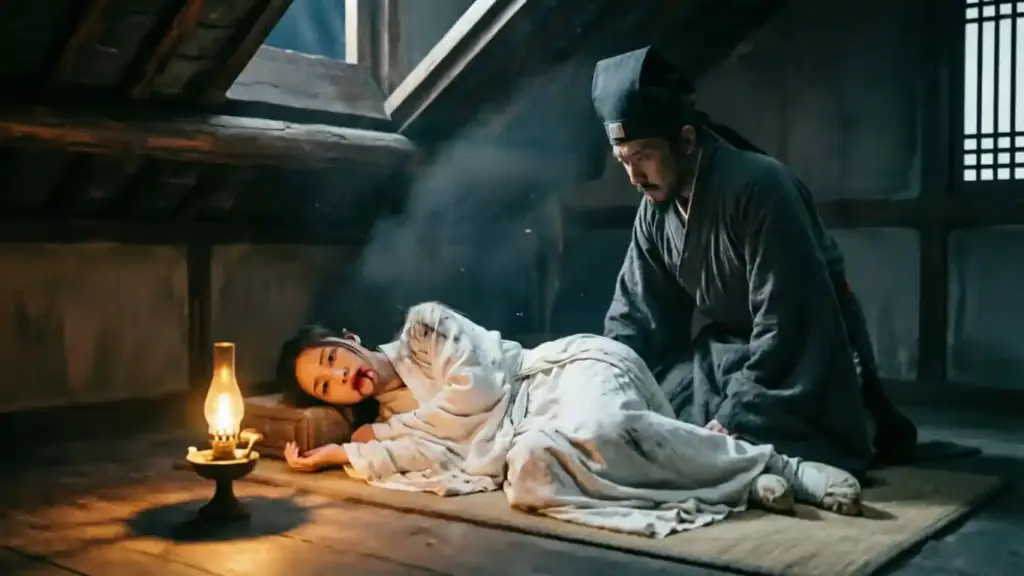
And what happened next would be told and retold for generations, until the line between fact and miracle blurred beyond recognition. At the third watch, in the cold darkness of the west prison, something stirred. The night guard, rubbing his eyes, saw the fingers of the corpse twitch. Then the chest rose and fell. By dawn, Shi Madu had opened his eyes, as if waking from a dream of inconceivable length, his body a map of pain but his life—by what grace no one could say—restored.
Word was brought to Lord Bao, who summoned Shi Madu to his private chambers at once. Through his sobs, Madu poured out the whole account of Sun Wenyi’s ambush: the groundless arrest, the cudgels, the seizure of the plaint. Lord Bao listened, told him to remain hidden within the residence, and began to lay a far more intricate trap.
The immediate problem was simple and immense: how to lure the Prince from his stronghold in the distant Western Capital to the Eastern Capital, where justice could reach him. If the mountain will not come to the judge, the judge must bring the mountain to him. Lord Bao thought, and a plan took shape. That very day, he announced that he was gravely ill and would hear no more cases. For days, he did not appear in court. The news spread, and the court officials murmured, and soon it reached the ears of Emperor Renzong himself.
The Emperor, concerned, sent an imperial physician to examine his most upright official. Lady Bao received the physician at the gate, her face drawn with feigned worry. “His Excellency is delirious,” she said, “and in his weakened state he fears the miasma of strangers. The physician may examine him through the screen, using a golden needle.” She placed a needle behind the screen. The physician tied a silk thread to his own wrist and attached the other end to the needle, and in the profound stillness of that room, he bent his concentration to the pulse. What he felt—or rather, what he did not feel—made his blood chill. The thread transmitted nothing, no flutter of life, no rhythm of a beating heart. He did not dare linger. He hurried back to the palace to make his report.
As soon as the physician was gone, Lord Bao and his wife exchanged a look of quiet complicity. “I may as well go all the way,” the judge said, “and die completely. Let us see whether the Prince takes the bait.” The two of them settled the details. Then he gave his wife careful instructions: “When His Majesty asks if I had any last words, you must say this and only this: ‘His sole concern was for the realm. He said that the Prince of the Western Capital is an upright official of rare talent, and should be appointed to succeed him as Prefect of Kaifeng.’ Remember it.”
The next day, Lady Bao appeared at court in the white hemp of deepest mourning, carrying the seals of office. She knelt on the golden pavement of the throne hall and delivered the “news” of her husband’s death. The assembled officials bowed their heads in sorrow; a murmur of lamentation ran through the ranks. The Emperor, remembering Lord Bao’s incorruptible rectitude, his ferocious integrity, his sleeves that held nothing but the wind, found his own eyes moistening. “Even at the end,” the Emperor said, his voice thick, “he thought only of the empire. He has recommended my own imperial younger brother to succeed him. His loyalty moves us deeply. We shall honour his final wish.” He issued an edict on the spot, appointing two senior ministers as imperial envoys to travel to the Western Capital and escort the Prince to his new post, and sending another envoy with sacrificial offerings to the Bao residence.
The envoys made their stately way west. In the great hall of the Prince’s mansion, the Prince knelt to receive the imperial decree. As its meaning sank in, a joy so fierce it nearly choked him surged up from his chest. He could scarcely believe it. Lord Bao—that black-faced, iron-skulled meddler—had recommended him on his deathbed? It was a gift from heaven, an unlooked-for windfall. He lavishly feasted the envoys, his face glowing with triumph, and gave orders to ready his carriages, his boats, his retinue. Within days, he set out for the Eastern Capital.
He arrived, and in the throne hall he knelt to express his gratitude. Emperor Renzong looked down at him and said, “It was Bao Wenzheng who, in his final hour, recommended you. We now bestow this high office upon you. We trust you will follow his example—incorruptible, clear-eyed, a discerner of truth from falsehood.” The Prince knocked his head to the floor and swore to obey, while inside him delight bubbled like a hidden spring.
The following day, the Prince, together with the newly confirmed Supervisor Sun Wenyi, set out in full procession to take possession of the Kaifeng Prefecture. Banners snapped in the wind, gongs and drums pounded, and the retinue moved through the streets like a triumphant army. But as they passed through the southern quarter, the common people, catching sight of the Prince’s standard, shuttered their windows and barred their doors. By the time the procession reached the main thoroughfare, the shops were closed, the street empty. The Prince, surveying the silence from his high saddle, felt rage prickle at the back of his neck. “These insolent wretches,” he muttered. “A new Prefect arrives, and they dare to hide behind locked doors?” His eyes narrowed, and he spoke to his captains. “My brothers-at-arms have travelled far and exhausted their travelling funds. Let every household on this street contribute one bolt of figured silk as a token of welcome.” His household troops fell upon the shuttered shops and houses like wolves. Doors splintered, chests were overturned, and anything of silk or value was ripped from its hiding place. The street filled with wailing and curses, a chaos of plunder and fear.
At the gate of the prefectural hall, the Prince dismounted and strode inside with the air of a conqueror entering his citadel. The first thing he saw was the long white funeral banner hanging in the centre of the great hall, its black characters stark against the white cloth. The clerks told him that Lord Bao’s coffin had not yet been carried out for burial, but still lay in the rear hall. The Prince’s face darkened. “I have deliberately chosen an auspicious day to take office,” he snapped, “and you people have kept this coffin here to spite me? Do you intend to curse me before I have even sat at the bench?”
Zhang Long and Zhao Hu, who had long since received the judge’s secret orders, slipped quietly into the back quarters to report. Lord Bao listened, and the faintest trace of a cold smile touched the corners of his lips. “Prepare the instruments of justice,” he said. “Let them wait in readiness.” He sent Lady Bao out to stall the Prince.
She came before him and bowed. “I beg the Prince’s indulgence,” she said. “The funeral date conflicts with the calendar. The coffin cannot be removed for another half-month.”
The Prince erupted. He loosed a torrent of abuse at her, standing there in her widow’s white—curses, insults, obscenities that should never have been uttered in the presence of a lady, let alone a woman in mourning.
He was still shouting when a figure stepped out from behind the side door.
The man’s face was as black as iron, and his eyes burned with a light that seemed to rise from the deep earth. He walked to the center of the hall with measured, unhurried steps, and when he spoke, his voice filled the cavernous space like the toll of a great bronze bell: “Prince Zhao. It has been some time. Do you still recognize this black-faced Bao?”
The Prince spun around. His eyes found that face—that unmistakable, impossible face—and his pupils shrank to pinpricks. His body locked rigid. His mouth opened, but no sound emerged. Into that stunned silence, Lord Bao’s command rang out like the crack of a whip: “Zhang Long. Zhao Hu. Seal the gates.”
The heavy vermilion doors swung shut with a boom that cut off the daylight and sealed every path of retreat. Bailiffs poured into the hall from every side. The Prince was seized and thrown into the west prison; Sun Wenyi was clapped into the east prison. A thick wall was all that separated them now, and neither could save the other.
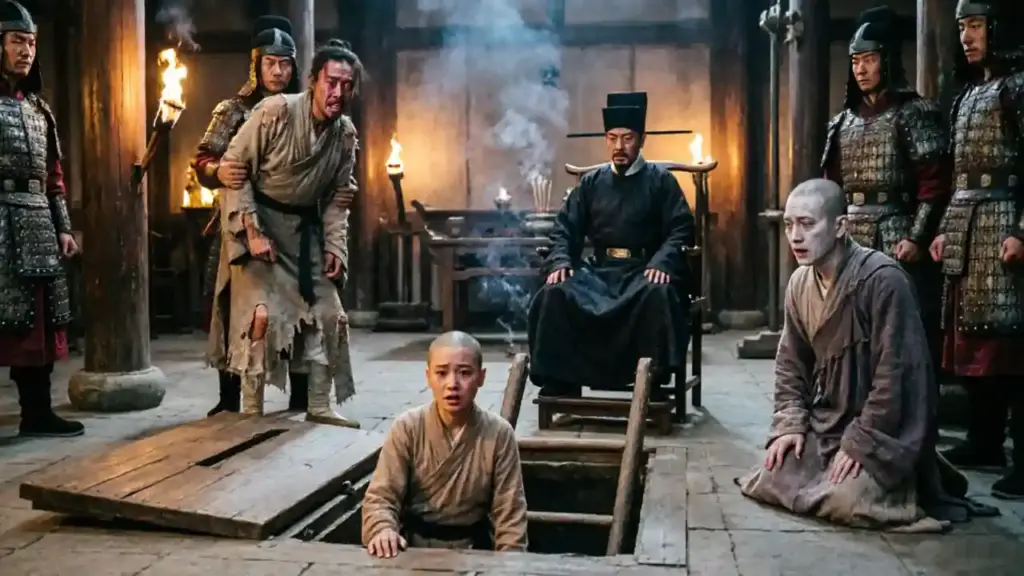
The next morning, Lord Bao ascended the bench. He gave orders for the empty coffin to be dragged to the front of the yamen and publicly burned. The flames roared up, and the black smoke coiled into the sky, and the watching crowd roared its approval. Then the Prince and Sun Wenyi were hauled from their cells, shackled and cowed, their faces the color of ash, and forced to kneel at the foot of the dais. Twenty-four executioners lined the hall on either side, and thirty-six instruments of judicial torment gleamed in the torchlight. Above the bench, the imperial edict of authority hung like a lowered blade.
Shi Madu was summoned to the hall. Standing before the kneeling Prince, he read aloud the plaint he had written in his own blood and tears, every word a dagger. The Prince, his arrogance still flickering, clamped his jaw and refused to confess. Lord Bao’s hand came down on the bench with a crack that silenced the hall. He ordered the full rigor of the law to be applied. The Prince, whose pampered body had never known a moment’s hardship, broke almost at once. Shaking, sobbing, he poured out the whole catalogue of his crimes: the abduction of Liu Dusai, the murder of Shi Guanshou, the slaughter of the household, the fire, the cover-up.
Sun Wenyi, watching his patron collapse, knew the game was over. He hung his head and confessed to his part: the letter, the cudgels, the body in the basket.
Lord Bao assembled the confessions, cross-referenced them with the statutes, and set down his verdict in strokes that bit deep into the paper: the Prince had stolen a wife, murdered the innocent, extinguished a family line—no punishment could be too severe. Sun Wenyi had abetted evil and trampled on human life; his crime was equal to the Prince’s. In his own hand, Lord Bao wrote the single character: Executed.
That afternoon, the judge himself led the executioners to the execution ground with the Prince and Sun Wenyi in chains. The news had spread like floodwater. The whole of the Eastern Capital emptied into the streets; the square around the scaffold was a sea of upturned faces. At the third quarter of the hour of the Horse, the signal cannon boomed. Two blades flashed in the winter sunlight. Two heads rolled into the dust. A roar went up from the crowd—a sound of pure, primal relief—and all across the city, families who had suffered at the hands of those two men lit incense and knelt in thanksgiving, hailing the Black-faced Judge who had rid the earth of a great evil.
The next morning, Lord Bao presented a full account of the affair to Emperor Renzong. The Emperor listened, and a long sigh escaped him. “When I heard that our beloved official had died,” he said, resting his hand on the desk, “I was so stricken with grief that I could neither eat nor sleep. Now I learn that it was all a stratagem to snare a monster. The evidence against the Prince and Sun Wenyi is overwhelming, and the executions were just. I feel nothing but relief.”
Lord Bao returned to his yamen and set about mending what could be mended. He arranged an escort to take Shi Madu and the boy Jinbao back to their homeland, and made provision for the funeral rites of Shi Guanshou and the rest of the murdered household. To Liu Dusai, who had been freed but had nothing left in the world—no husband, no home, no child she could look upon without seeing all that had been taken from her—he offered words of quiet comfort, and granted her the right to return to the Shi family and live out her days in chaste widowhood, keeping faith with her slaughtered husband. The members of the Prince’s household who had helped him in his villainy were stripped of their ranks and expelled. The confiscated wealth of the Prince’s mansion was divided: half entered the imperial treasury, and half was bestowed upon Uncle Zhang—the loyal old steward whose stubborn courage had brought a prince to justice and avenged an ocean of innocent blood. In his final decree on the matter, Lord Bao wrote a special commendation of the old man’s righteousness, the last flicker of warmth and light in a tale that had, for so long, known nothing but darkness.