In the town of Jianzhou, there once lived a young man named Xu Long. His family’s poverty was so absolute that the very walls of their hovel seemed to hoard the winter’s chill and radiate a perpetual, gnawing hunger. His father had passed early, leaving behind only an aging mother who often endured days without a proper meal. His younger brother, Xu Qing, was sturdy and willing, toiling for whatever meager wage he could scrape together to keep their mother alive.
But Xu Long was cut from different cloth. He had no aptitude for manual labor, spending his days in idle drift, his hands soft and his prospects even softer. His mother, worn threadbare by want and worry, took to scolding him with bitter, relentless tongue. Her words stung until he could no longer bear the sound of them.
Swallowing his pride and a hard, silent anger, Xu Long sought out his closest friend, Feng Ren. Together, they resolved to seek their fortune in the distant province of Yunnan, trading whatever goods they could carry. They departed without fanfare, and for over a decade, not a whisper of them returned to Jianzhou.
Then, against all odds, fortune finally turned its face toward Xu Long. He had amassed a tidy sum in silver—enough to alter a man’s destiny—and at last, he set out for home, the weight of his success strapped close to his body in a heavy cloth bundle.
He reached the borders of his native region as dusk began to bleed across the hills. At a lonely ferry crossing known as Jieji Du, the old ferryman, Zhang Jie, poled his skiff toward the bank. The two men recognized each other instantly, exchanging the guarded pleasantries of old acquaintances. Zhang Jie’s eyes, sharp and knowing, swept over the traveler.
“Master Long,” he said, a smile stretching his leathery face, “after so many years away, you must have made your fortune abroad.”
Xu Long was bone-weary from the road, his breath coming short. “I’ve put a little aside,” he replied, downplaying the truth. “Nothing worth boasting of.”
With that, he tossed his oil-paper umbrella and the heavy bundle into the bottom of the skiff. The bundle landed with a deep, solid thump against the wooden planks—a sound too dense, too full, to be anything but silver. Zhang Jie had spent his life reading the river, the weather, and the faces of men; that single sound told him everything.
In that instant, a dark flame kindled in the old ferryman’s chest.
Night was closing in fast. The river lay empty and grey beneath a sky devoid of witnesses. There was no one else at the crossing. Gripping his long bamboo pole, Zhang Jie stole up behind Xu Long, who was still settling himself in the boat. With a sudden, savage swing, he brought the pole crashing against the back of the traveler’s skull. Xu Long pitched forward without a cry and plunged into the black water. The river swallowed him whole, and the ripples smoothed over as if he had never existed. Darkness folded itself over the scene; no one saw.
Zhang Jie secreted the heavy bundle of silver away and carried it home under the cover of night. From that day, his fortunes bloomed like a poisonous flower. He bought land, expanded his house, built new courtyards, and lived with the comfortable swagger of a man who had never known hunger. To complete the picture, he engaged a private tutor for his seven-year-old son, Zhang You.
The tutor often praised the boy in his father’s presence. “Your son is remarkably bright,” he would say. “His poetic couplets are outstanding.” Zhang Jie always suspected polite flattery.
When the Dragon Boat Festival arrived, Zhang Jie laid out wine and dishes and invited the tutor to drink with him. Half into his cups, warmed by the wine, Zhang Jie said, “Sir, you have often told me my boy has a gift for matching couplets. Today being the festival, why don’t we test him with a suitable line?”
The tutor smiled indulgently. “Given your son’s natural talent, a couplet is no great challenge.” He thought for a moment and then spoke the first line aloud:
“With yellow silk you bind the zongzi, hanging loyal souls above the Miluo River.”
It was a poetic image of remembrance, the silk-wrapped rice dumplings cast into the waters where the martyred minister Qu Yuan had drowned himself centuries before.
Zhang You furrowed his brow and bowed his head, thinking hard. But the line was steeped in allusion and nuance, and his mind remained stubbornly blank. The silence stretched. Zhang Jie’s expression darkened. The tutor shifted in his seat, his embarrassment deepening. The boy’s face burned scarlet. At last, unable to bear the pressure, he mumbled something about needing the outhouse and fled the table.
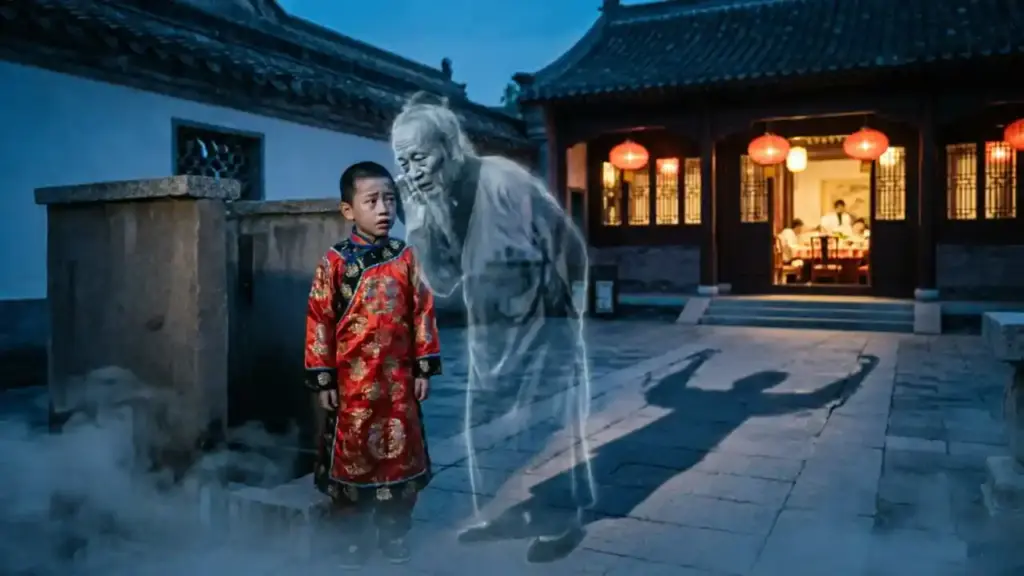
He stood in the dim yard beside the latrine, miserable and frustrated. Then, all at once, he felt that he was no longer alone. An old man stood close by, a figure Zhang You had never seen before, his features indistinct in the failing light.
“You look troubled today,” the old man said quietly. “What’s the matter?”
Zhang You sighed, grateful for any ear. “My father made our tutor set a couplet at dinner, and I couldn’t answer it. It was too hard. I ran out here to escape the shame.”
“What was the first line?” the old man asked.
Zhang You recited it dutifully: “With yellow silk you bind the zongzi, hanging loyal souls above the Miluo River.”
A strange laugh escaped the old man, soft and laced with a chill the boy couldn’t quite name. “That couplet is hardly a riddle,” he said. “I shall match it for you.”
Hope flared in Zhang You’s eyes. “Truly?”
The old man spoke the answering line slowly, savoring each syllable as if tasting a bitter wine:
“With purple bamboo you shoulder the load, plotting against the far-returning guest at Jieji Du.”
Purple bamboo was the timber of porters’ poles. And Jieji Du—the very ferry crossing where a returning guest had been plotted against and murdered for his silver—was a name wrapped in verse like a blade in silk. Zhang You understood none of this; he saw only the perfect symmetry of the words, the neat mirroring of image to image. Delighted, he thanked the stranger and raced back inside.
“I’ve done it!” he burst out at the table. “Sir, I’ve matched the couplet!”
The tutor looked up, startled and pleased. “You have? Speak it, then.”
Drawing himself up, the boy declared:
“With purple bamboo you shoulder the load, plotting against the far-returning guest at Jieji Du.”
The color drained from Zhang Jie’s face. In an instant, he turned the grey of cold ash. His hand jerked, nearly spilling his wine. The tutor, missing the deeper resonance, pursed his lips and said mildly, “It matches the form, I suppose, though the sentiment is rather unrefined.”
But Zhang Jie was already on his feet, his voice cracking with something close to terror. “You didn’t compose that line yourself! Who taught it to you? Tell me now, or I’ll flog the truth out of you!”
The boy shrank back, trembling. Under his father’s furious gaze, he stammered out the whole story—the old man by the latrine, the mysterious stranger who had given him the couplet. Zhang Jie demanded, “Is the old man still there?” Zhang You answered in a small, frightened voice, “I didn’t look back. I don’t know.”
Zhang Jie shoved himself from the table and rushed out into the yard. He searched the area around the outhouse, circled the courtyard, and peered into every shadow—but there was no one. No footprints, no stirring of air. The yard lay empty and unnervingly still. A chill crept up his spine and settled at the nape of his neck like a cold, dead hand.
He understood then. That second line had named the crime precisely: plotting against the far-returning guest at Jieji Du. No living soul could have spoken those words with such knowing precision. No one but the man he had struck down into the black water all those years ago. The vengeful ghost had come back.
Terror unspooled his mind. Zhang Jie began to shake uncontrollably, his lips working, his eyes staring at things no one else could see. In front of the astonished tutor, in a raving, broken rush of words, he confessed everything—the ambush at the ferry, the bamboo pole, the stolen silver, the silence of the water. Every detail poured out of him like poison lanced from a festering wound.
He did not know that, just outside the window, his nephew Zhang Ben had been listening. The younger man had long nursed a bitter grudge against Zhang Jie over a dispute about family property. Now he had stumbled upon a secret worth more than any parcel of land. The next morning, he took brush and paper, wrote out a detailed accusation, and delivered it straight to the county magistrate.
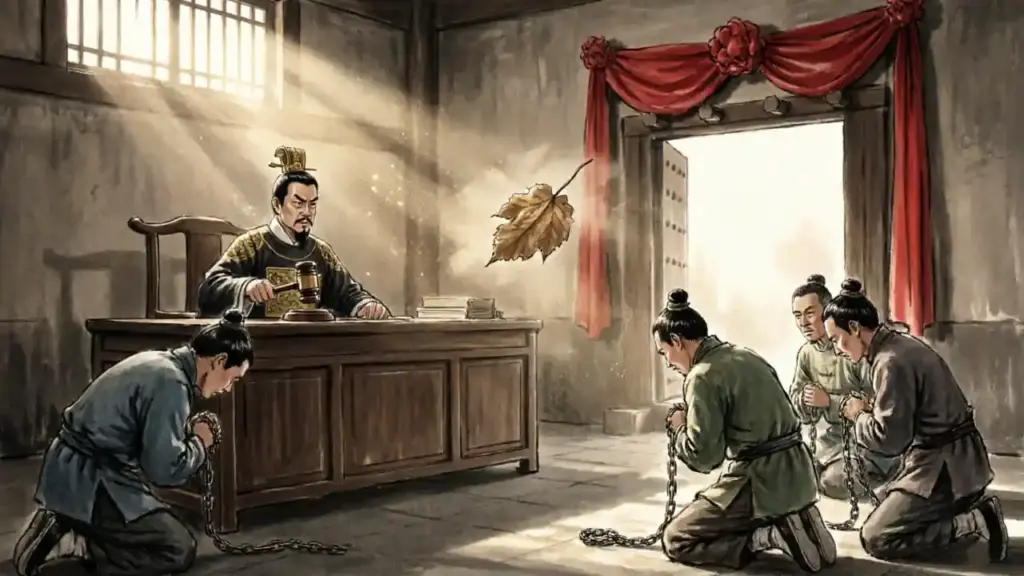
Magistrate Dong read the charges with mounting gravity. The crime was capital, the accusation chillingly credible. He dispatched five of his sharpest runners to Zhang Jie’s home, where they seized the man without warning and hauled him to the yamen in chains.
Kneeling on the stone floor of the courtroom, Zhang Jie looked barely human—his face grey, his limbs quaking, his hands clawing at the empty air. Magistrate Dong took one look at him and knew the truth was close to the surface. He ordered the formal interrogation to begin. Under the press of irons and the lash of questioning, Zhang Jie’s resistance crumbled. Piece by piece, he laid bare the crime: how he had seen the heavy bundle, heard that solid thump in the boat, let greed overwhelm him, struck the fatal blow, and let the water bury the evidence. He signed the confession with a trembling hand.
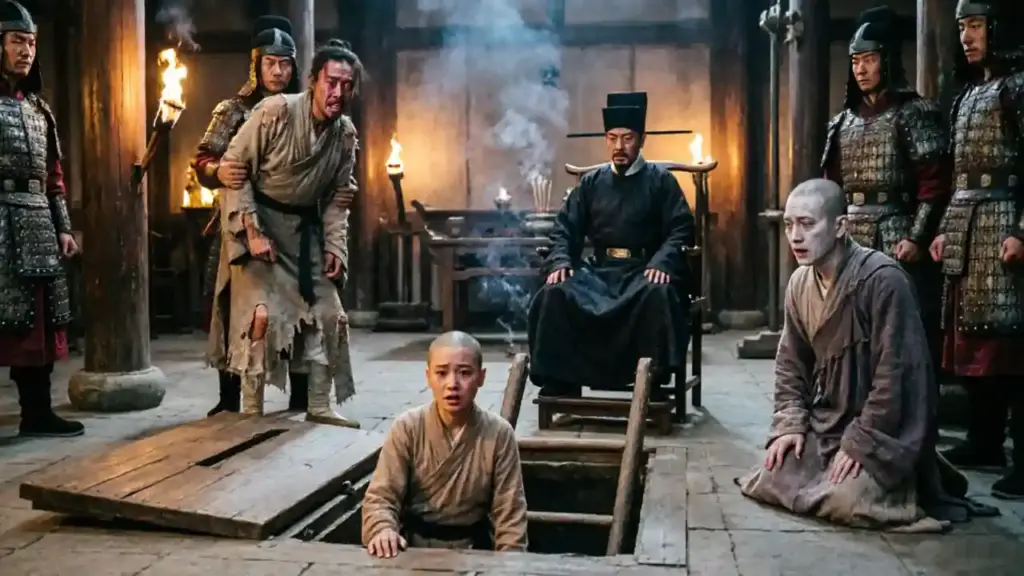
The magistrate pronounced the verdict immediately. Zhang Jie was consigned to the death cell and loaded with a heavy cangue. The report was sent up the chain of jurisdiction with all speed. As it happened, the great Lord Bao was passing through the region on a tour of inspection. He reviewed the case personally, confirmed the sentence, and ordered that Zhang Jie should pay for the murder with his own life. The lands, houses, and holdings built on blood money were confiscated by the state. By then, Zhang Jie’s wife and son, seeing the ruin bearing down upon them, had fled into the night. The authorities did not pursue them further.
The river at Jieji Du flows on, day after day, unchanging. Travelers come and go at the ferry, busy with their own lives, as if nothing ever happened there. Yet some boatmen who pass at dusk have claimed, from time to time, that they hear something drifting across the water—a sigh, low and faint, like breath long submerged, rising briefly before the current carries it away.