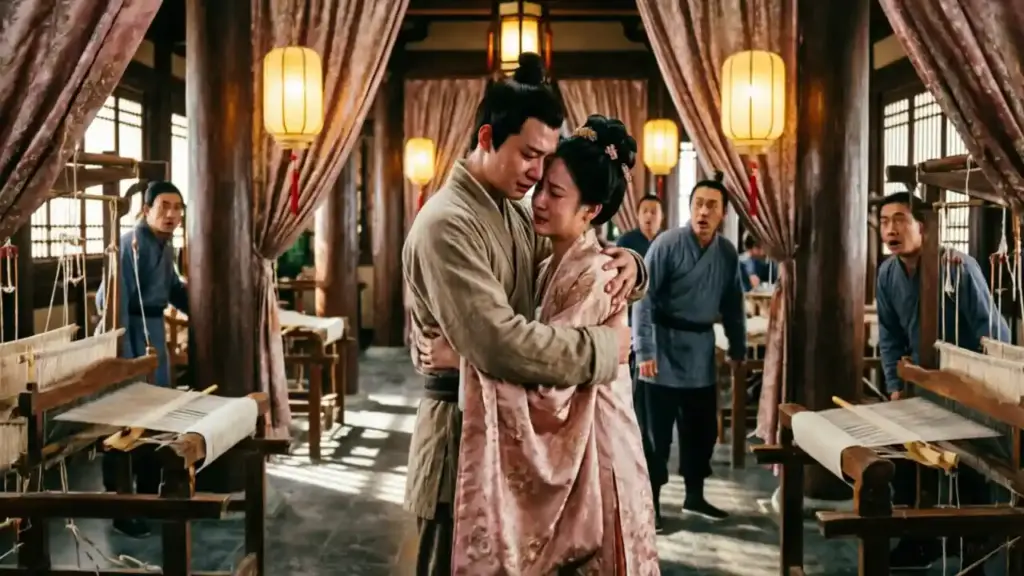
In the misty jurisdiction of Wu County, Suzhou, there lived a boatman named Shan Gui, whose brother-in-law, Ye Xin, served as his oarsman. To the casual observer, they were humble ferrymen, earning an honest crust by hauling passengers and cargo along the serpentine waterways. Yet, beneath the placid surface of their trade lurked a sinister vocation: they were predators of the river, preying upon the very merchants who hired them. These unfortunate souls vanished from the decks without a trace, their riches melting into the men’s pockets like morning mist into dark water.
It so happened that a Huizhou merchant named Ning Long journeyed to Suzhou with his servant, Ji Xing, to procure fine silks and satins. Carrying a fortune of over a thousand taels of silver, Ning Long concluded his business and descended to the wharves, seeking a vessel for the voyage to Jiangxi, where he intended to turn a handsome profit.
Shan Gui spotted the merchant from across the dock. Instantly, his face arranged itself into a mask of earnest welcome. He hurried forward, assisting with the cargo himself, his words as smooth as oiled silk. Before Ning Long could fully grasp the situation, he and Ji Xing were aboard, their goods stowed, and the mooring lines cast off.
At dawn, they slipped away from Suzhou. For five days, the boat traced a quiet course toward Jiangxi. Then, at dusk on the fifth evening, they reached a place called Zhangwan. Shan Gui steered the vessel into a secluded inlet, a silent bend of water where reeds grew thick and no other boats dared to pass.
That night, Shan Gui produced wine and rich delicacies. The four men gathered in the cabin, with the hosts pressing cup after cup upon their guests. Their smiles never wavered, their praise never faltered, and the wine flowed like a river. Ning Long and Ji Xing, undone by such relentless hospitality, were soon slumped in their seats, dead to the world.
By the second watch, silence had descended. A few cold stars and a sliver of moon cast their indifferent light upon the river. Shan Gui and Ye Xin exchanged a glance that required no words. Quietly, they poled the boat from its mooring, guiding it out toward the deep, racing current. There, they set aside their poles. Each man seized a body—one the master, one the servant—and heaved them over the side.
Ji Xing, drowned in drink, never stirred. The water closed over his head without a struggle, and the river claimed him for its own.
But Ning Long was not fated to perish that night. A strong swimmer since boyhood, the shock of the icy river jolted him half-sober. Instinct took over. He dove with the current, deeper into the darkness, until his flailing hands found a broken log drifting in the water. He clung to it with the grip of a dying man, surrendering himself to the river’s will.
He drifted for what felt like an eternity. Then, piercing the blackness, he saw the silhouette of a large junk gliding toward him. Summoning the last shreds of his strength, Ning Long cried out.
A man stood on the deck—Zhang Jin, Ning Long’s maternal cousin. The voice that reached him across the water struck a chord of familiarity, the unmistakable accent of home. Zhang Jin ordered his crew to lower a pole at once. When they hauled the dripping figure aboard, he found himself staring into the face of his own kin.
Shock gave way to joy, and joy to urgent concern. Zhang Jin wrapped his cousin in dry clothes, pressed hot wine into his trembling hands, and listened as the harrowing story spilled out—the false kindness, the drugged wine, the cold plunge, and the servant lost to the depths. By the time Ning Long finished, Zhang Jin’s fists were white at the knuckles, his jaw set hard with fury.
At first light, they hired another boat. Word had reached them that the renowned Judge Bao was currently on a circuit trial in the Wu region. Without delay, they set out to present a formal complaint.
The petition Ning Long submitted was written in characters that seemed to weep blood:
A plea against those who plot murder for gain:
Wicked men who prey upon the innocent, boatmen who are tigers crouching at the river’s edge. A merchant far from home, his capital sunk, like a fish stranded in a drying pool. I carried a thousand taels of silver, a single servant at my side, to Suzhou to buy silks, bound for Jiangxi to trade. I sought a boat and hired these men—Shan Gui the boatman, Ye Xin the oarsman—who took us aboard with our cargo. At Zhangwan, they anchored, brought out wine, and plied us until we fell senseless. Then they thrust master and servant into the river’s heart. A lonely traveler came under the moon; a single pole pushed the boat into the reeds. When all human voices had faded, two pairs of hands busied themselves casting bodies into the green deep. The servant drowned, his life given to the fish; the master, by grace, was rescued by Zhang Jin. These villains rejoiced that no eye witnessed their crime, forgetting that Heaven sees all. I beg the court to recover what was stolen and render justice.
Respectfully submitted.
Lord Bao read the petition with grave care, his brow furrowing deeper with every line. When he finished, he issued arrest warrants without hesitation, dispatching officers to seize Shan Gui and Ye Xin.
The officers returned half a day later, empty-handed. The men had vanished. Lord Bao ordered Shan Gui’s wife and household taken into custody and placed Ning Long under the court’s protection. Then, he summoned two of his most capable detectives, Xie Neng and Li Jun, issued them official credentials, and sent them along the waterways to hunt their quarry with discreet, dogged determination.
Meanwhile, Shan Gui and Ye Xin had not been idle. The very night they cast their victims into the river, they had transferred the cargo to a smaller boat, leaving the empty vessel moored at Zhangwan to feign an attack by river bandits. They sailed the silks and satins to Nanjing, selling the lot to a dealer for thirteen hundred taels of bright, heavy silver. Business concluded, they turned their little boat around, drifting back toward Zhangwan to reclaim the empty hull.
And there, at Zhangwan, the net of Heaven snapped shut.
Xie Neng and Li Jun were waiting. Shan Gui, ever the performer, hailed them with an easy smile. “Are you gentlemen returning to Suzhou? Come aboard, travel with us.” The two detectives accepted without a flicker of hesitation. They journeyed together, day after day, until the walls of Suzhou rose before them.
The moment the boat touched the bank, Xie Neng and Li Jun produced iron chains from their sleeves. The shackles snapped shut around Shan Gui and Ye Xin with the cold, final sound of a closing jaw. The blood drained from the boatmen’s faces.
“On what charge?” Shan Gui cried, his voice climbing in panic. “You chain us without cause!”
Xie Neng’s smile was thin as a razor. “You’ll have your answer soon enough. The judge is waiting.”
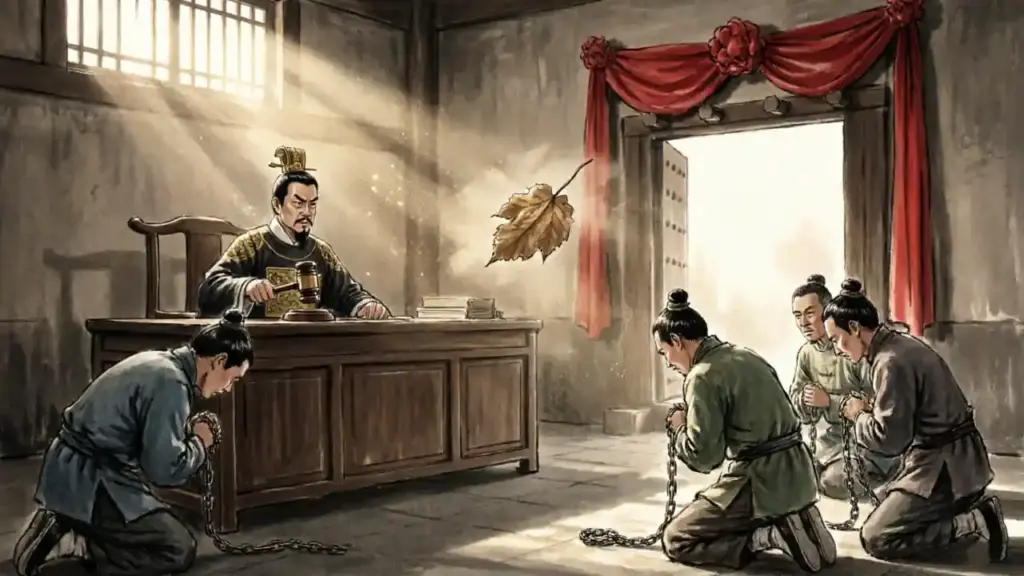
They were marched through the city gates directly to the tribunal, where Lord Bao was already presiding. The officers presented their prisoners, and Lord Bao dispatched four bailiffs to strip the boat of every trunk, bundle, and scrap, ordering it all brought to the court.
When the possessions were piled before the bench, Lord Bao spoke. “Shan Gui. Ye Xin. You murdered Ning Long and his servant for their silver. How much did you take?”
Shan Gui straightened his neck, meeting the judge’s eye with feigned defiance. “I have never murdered anyone. I know no Ning Long.”
“You have been identified,” Lord Bao said, his voice steady. “Ning Long hired your boat for the journey to Jiangxi. Midway, you plotted his death. Do you still deny it?”
“He hired my boat, that is true,” Shan Gui conceded. “But we were attacked by bandits on the river. I barely escaped with my own life. How could I have looked after him?”
Lord Bao’s voice turned to ice. “You drowned him in wine and threw him into the river. Guards—forty strokes of the heavy bamboo, for each of them.”
The heavy bamboo fell. Ye Xin writhed in agony, yet he still found the breath to protest. “Even if such a crime had been committed, where is your accuser? Where is your proof? You arrest us on rumor, you beat us on suspicion—how can we submit to this injustice?”
Lord Bao looked down from the bench, his gaze as steady and unblinking as a votive flame. “You stand in my court now. Your submission is not required. Confess, and spare yourselves further torment. Refuse, and we shall see what the presses have to say.”
The torturers brought forth the ankle crushers. Shan Gui and Ye Xin endured the crushing agony with clenched teeth, their faces draining of color, yet their denials remained unbroken. The stalemate held.
Then, the bailiffs returned from the boat, bearing the last of the recovered possessions. They laid the items out one by one on the vermilion pavement below the bench. Lord Bao ordered Ning Long to be brought from his quarters to identify them. The merchant examined each object with painstaking care, turning them over in his trembling hands. His face fell. Not a single one of these mundane items belonged to him. No silver. No silks.
Seeing this, Shan Gui drew fresh courage from the void. “Ning Long!” he spat, his voice thick with defiance. “Where is your conscience? That night, when the bandits attacked, they threw you into the water. Why do you not accuse them? Why do you turn your malice upon us? Heaven is watching!”
“There were no bandits that night!” Ning Long’s voice shook with a mixture of rage and grief. “It was you—you two—who drowned us in wine, rowed us into the current, and cast us into the river. You have hidden my goods somewhere. That is why you stand here with lying tongues.”
Lord Bao listened to the heated exchange, a flicker of doubt crossing his mind. If these men had truly robbed Ning Long, why was there not a single shred of evidence on the boat? Where had a thousand taels’ worth of cargo vanished to? He deliberated for a long moment, the silence in the court heavy and suffocating, before ordering the prisoners held overnight. Judgment would resume at dawn.
When the morning light broke, Lord Bao ascended the bench once more. This time, he ordered Shan Gui and Ye Xin to be separated—Shan Gui to the eastern corridor, Ye Xin to the western—ensuring they could exchange neither a word nor a glance.
He summoned Ye Xin first.
“The night of the attack,” Lord Bao began, his voice deceptively calm. “How many bandits were there? How were they dressed? Describe their leader.”
Ye Xin answered readily, his story rehearsed. “It was the third watch. We four were asleep in the cabin when a gang of thieves pulled the boat into the current. Their leader was a tall, burly man in a dark coat, his face painted in savage colors. He leaped aboard first. Three smaller boats surrounded us. Ning Long and his servant panicked at the sight of the bandits and jumped into the river from the stern. The thieves seized me and began to beat me. I begged them to stop, telling them I was only the boatman. They let me go, took the cargo, and fled. Now Ning Long slanders me with false accusations. He has no conscience.”
Lord Bao’s expression remained unreadable. “Stand aside in the western corridor.”
He called for Shan Gui.
“The bandits who attacked your boat—how many? How were they dressed? Describe them.”
Shan Gui’s account flowed as smoothly as Ye Xin’s, yet the details began to diverge. “Third watch. They pulled us into the current. Seven or eight small boats surrounded us. One of them, a young man in a red coat, jumped aboard. He threw Ning Long and his servant into the water himself. He was about to throw me in too, but I cried out that I was the boatman, not a passenger, and he let go. Otherwise, I would have drowned with them.”
Lord Bao laid the two written confessions side by side. The number of attackers, the number of boats, the color of the clothing, the leader’s description—every detail contradicted the other. A slow, hard smile touched the judge’s lips. He now had eight or nine parts of the truth.
He ordered the presses brought once more. Shan Gui and Ye Xin, clamped tight within the torture devices, still refused to break. “You say we robbed him,” they cried through gritted teeth. “But we never returned home. Where could we have hidden the goods?” They had resolved to die before admitting anything.
Lord Bao saw that further torture in the courtroom would yield nothing. He sent them back to their cells. But a thought had begun to stir at the back of his mind, a quiet, nagging intuition: There is something on that boat I have not seen.
He went there himself.
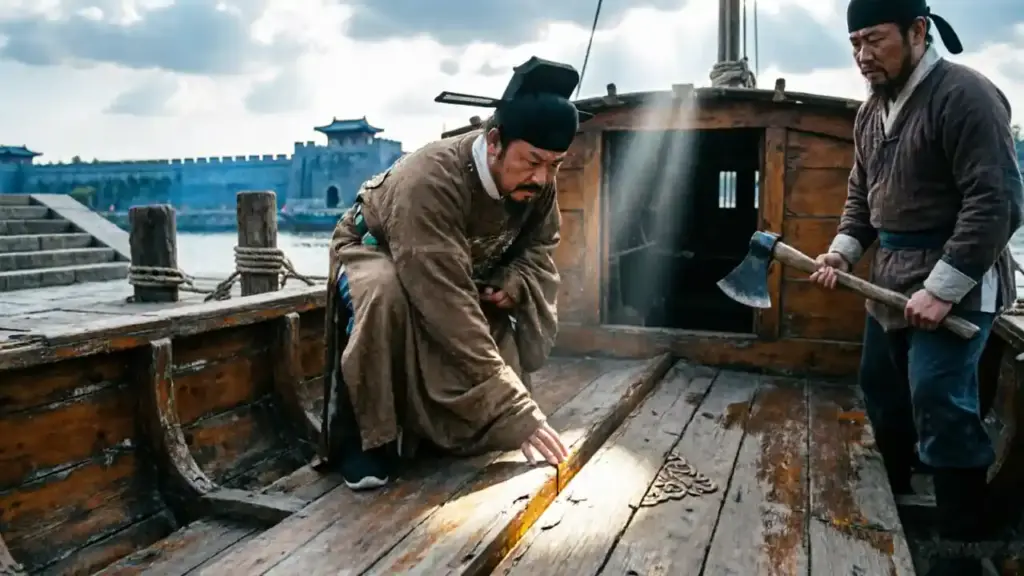
His sedan chair carried him to the wharf, and he stepped aboard the vessel to examine it with his own hands. The deck was empty, unremarkable. He crouched low, running his palm along the planks of the hull. And then—his fingers found a seam. It was smooth along the edges, too even, the fit too deliberate for an ordinary joint. He ordered his men to pry at it. Beneath, hidden catches resisted their efforts, mechanisms designed to defeat casual inspection.
“Axes,” Lord Bao commanded. “Break it open.”
They smashed through the concealed bolts. The panel lifted—and the men around him drew a collective, sharp breath. In the false bottom of the boat, packed as tight as a miser’s chest, lay a trove of goods. Clothing, household items, traveling cases. And two leather trunks. The lids flew open.
Silver. Bright, heavy silver, gleaming in the daylight.
The bailiffs hauled the entire hoard back to the tribunal. Lord Bao summoned Ning Long once more.
The merchant took one look and tears spilled down his face. “Before—those things were not mine, and I dared not claim them. But these—these are all mine. All except that one new trunk.”
Shan Gui and Ye Xin were brought before the bench. Lord Bao gestured at the mountain of recovered goods. “These hardened wretches refused to confess. Tell me—whose property is this?”
Shan Gui’s composure cracked, but he held to his lie. “Left behind by other passengers,” he said. “What has it to do with him?”
Ning Long stepped forward and placed his hand firmly on an old leather trunk. “You say others left this. You probably destroyed the ledger inside. But this trunk—this old one—it bears the brand of the character ‘Ding’ on its left side. Tell me, Shan Gui, did the brand grow legs and walk away too?”
Lord Bao ordered the trunk opened. There it was, burned into the leather, unmistakable: 鼎.
The color drained from Shan Gui’s face. His legs gave way beneath him. Beside him, Ye Xin crumpled like a man whose bones had turned to water.
Lord Bao ordered sixty more strokes of the heavy bamboo. This time, the dam broke. The words came spilling out—the silks and satins sold in Nanjing, the thirteen hundred taels of silver they had fetched, divided evenly between them, each man’s share packed into a trunk. The silver in the trunks was the very silver now gleaming on the courtroom floor.
Lord Bao delivered his verdict:
This court finds that Shan Gui and Ye Xin, consumed by greed and bereft of righteousness, plied a small boat to carry cargo, then plotted murder to enrich themselves. The merchant Ning Long, tragically, stepped aboard a vessel of thieves. After days of travel, they plied him with wine—a trap concealed in a cup, a blade hidden in a smile. While he lay senseless in drunken sleep, they poled the boat into deep water and, in the stillness of the night, cast him and his servant into the river’s heart. They believed master and man alike would feed the fish, and rejoiced that the fortune had fallen into their laps. But though the deed was done in darkness, Heaven keeps its own watch. The servant perished, but the master was saved. He sought justice, and the court dispatched men to ensnare the criminals upon the river. Finding no obvious plunder, the murderers argued with silver tongues. Yet when the false bottom of the boat was breached and the silver and goods brought to light, even those forked tongues could weave no further defense. The crimes admit no pardon. Let the full penalty of the law be applied: death by execution, to answer for the wrongful slaying of Ji Xing. The stolen goods shall be restored to their rightful owner, that Ning Long may have the means to return home.
The sentence was death by beheading, to be carried out in autumn. Shan Gui and Ye Xin would meet the executioner’s blade, answering at last for the blood that cried out from the river.
And so it was that the scheming of wicked men, however intricate, unraveled at last beneath the clear, unblinking gaze of the law.