The Gossip and the Bloody Tongue
In the ancient city of Xi’an, there lived a man of immense fortune, Nie Chonggui. His wife, of the Tang family, had borne him four sons. The eldest, Kexiao, shouldered the burdens of the household; the second, Keti, plied his trade in distant provinces. The third, Kezhong, was the scholar of the family. He had earned his degree early and carried the weight of literary promise on his young shoulders. Year after year he sat for the higher examinations, poised always on the brink of triumph. In the meantime, he tutored his youngest brother, Kexin, with a tenderness that bound the two together like silk thread—where one went, the other was sure to follow.
Then misfortune struck.
Kezhong failed the examinations. Shortly after, a fever lashed him to his bed, consuming him from within. Kexin came hour after hour to his brother’s room, and what he saw there filled him with a cold, creeping dread. Their sister-in-law, Shuzhen, was a woman whose beauty stopped the breath—flowers must have paled in envy beside her. Kezhong lay wasted and weak, and Kexin, watching, whispered to himself that perhaps a dying man should not gaze upon a face so lovely. Desire, even the shadow of it, might drain the last drop of life from his brother’s brittle frame.
He resolved to move Kezhong to the quiet of the study, where peace and solitude might coax back some thread of health. But Shuzhen loved her husband with a fierce, desperate love. “A sick man must not be moved,” she said, her voice soft and unyielding. “And who in the study would tend to him? Here, in our chamber, I am always at hand with his broth and his medicine.”
Her words sprang from pure devotion; there was nothing of wantonness in her, nothing hidden or calculating. Kexin, though uneasy, let the matter drop.
When friends and relatives came to inquire after the invalid, they spoke in mournful tones of Kezhong’s relentless study. But Kexin, tears spilling down his cheeks, answered bitterly, “My brother is dying not because of books. Since when have great heroes fallen only to the blade? More have perished at the hands of women.”
The visitors exchanged startled glances and soon took their leave.
The air in the sickroom grew heavier. When the hour of death drew near, Shuzhen, in a panic, called out for Kexin. He came, but his steps were heavy with old resentment. “Before, you would not let me move him to the study,” he said, his voice a blade held steady. “Why do you summon me now?”
Shuzhen’s face tightened with sorrow, but she said nothing. Kexin approached the bed. Kezhong, gasping, grasped his brother’s hand. “I am slipping away,” he said. “Study hard, bring honor to our name, do not fail me in this. My widow is chaste and still young—treat her with kindness, I beg you.”
Then his breath stilled.
Kexin’s grief was a storm that tore through him. He performed every death rite without a single omission, buried his brother with all the weight of duty and sorrow, and thereafter waited upon the widow with a reverence so careful it seemed to bruise the air between them.
The entire household looked upon Shuzhen with mingled pity and respect. For seven weeks of ritual mourning, monks and Daoist priests chanted sutras for the dead, and Shuzhen’s weeping was so harrowing that for fifteen days she took neither water nor gruel. Her flesh melted from her bones; she became a specter of grief. Only after the hundredth day, when her own parents and the elder women of the family gathered to soothe her with gentle words, did she begin to eat a little and find her way back to something like life.
Her beauty returned as well—fresh as spring, graceful as a willow swaying at dawn. She wore no jewels, painted no powder on her cheeks, yet her natural radiance was enough to stir the heart of any man who looked upon her. But she was a woman of iron restraint, her words few and pure, her conduct blameless as clear water. Nothing improper could cling to her.
As the first anniversary of Kezhong’s death approached, Shuzhen’s father, Jiang Guangguo, made preparations. He brought Daoist priests from the Temple of Purple Clouds, all of them kinsmen of the Jiang clan: his nephew Jiang Jiayan, who would serve as high priest; his disciple Jiang Daheng; and the disciple’s own disciples, Jiang Shihua and Yan Huayuan. Together they performed the great mourning rite.
Kexin, watching from the edges, looked deeply displeased.
At last he said to Guangguo, “Old uncle, your kindness is great, but this ceremony—what use is it, truly?”
Guangguo’s face darkened. Going inside to find his daughter, he said, “I came to honor your husband with a pure heart, and your young brother-in-law shows me nothing but coldness. If he treats his elder brother’s memory with such slight regard, what regard do you imagine he has for you?”
Shuzhen’s voice, when she answered, was brittle with remembered hurt. “When he wished to move his brother to the study, I kept him here with me to nurse him. When my husband died, Kexin’s anger fell on me. For a full year now he has hardly looked at me. Tell me—can such a man be called kind?”
Guangguo’s resentment toward Kexin curdled into something darker.
When the rites drew near their close and the moment came to summon the wandering soul, Guangguo called to Shuzhen, “The priests are all our own family. There is no harm in your coming to the spirit tablet to bow.”
Shuzhen, her heart already drowned in sorrow, entered the hall and prostrated herself before the altar. The lecherous Daoist Yan Huayuan, the moment his eyes fell upon her, felt his mind darken with desire. They always said Shuzhen was a beauty beyond compare, he thought, but to see her now, even in the raw linen of mourning, even hollowed with weeping—if she were free of sorrow, smiling, joyful, she would drive a man quite mad. In that instant, a foul seed of lust took root in him and began to grow.
Deep night fell; the rituals ended. The priests offered their farewells and prepared to depart. Guangguo said to Shuzhen, “Jiayan, Daheng, and Shihua are our own flesh and blood—they will not cavil at a modest token. But Master Yan is an outsider; he must be thanked with generosity.”
Shuzhen set aside an additional gift of silver and had it pressed into Yan’s hands. But Yan Huayuan had already woven a darker plan. With a smirking word about leaving first, he made a show of departing, then slipped back into the shadows. He crept up to the high loft above the chamber and hid himself there, waiting till the house fell silent.
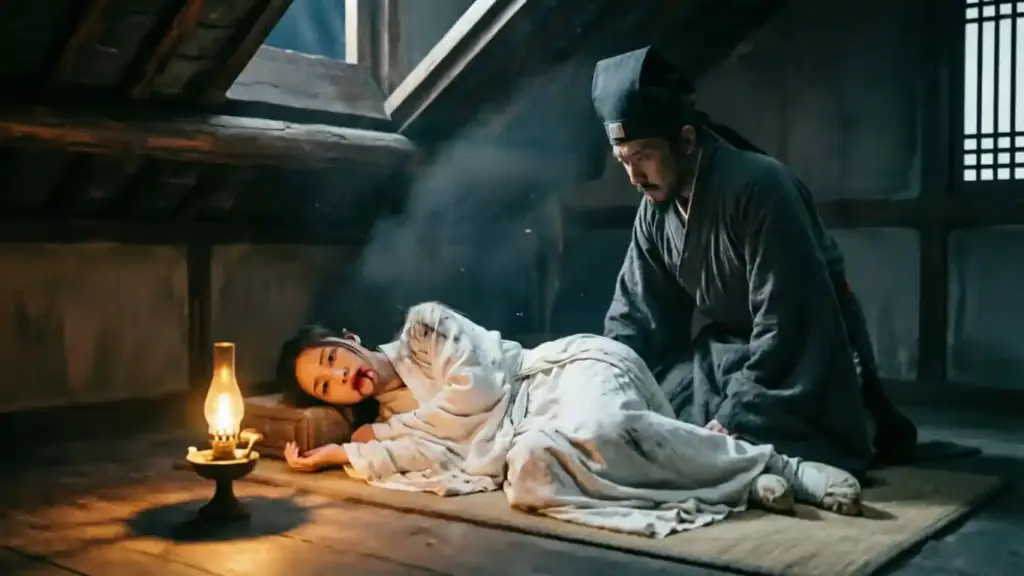
Then, making a small scurrying sound like a rat, he lured Shuzhen to rise with a candle in her hand. As she peered into the darkness, he flung a sorcerous powder upon her—a wicked aphrodisiac used by debauched priests to force their way with women. The moment it touched her skin, Shuzhen’s reason dissolved. A feverish lust flooded her limbs, and she fell into Yan’s arms, lost in an abyss of unholy pleasure.
When daylight broke and the drug’s power ebbed, Shuzhen came to herself and understood in one annihilating instant what had befallen her. The defilement was absolute, her chastity shattered beyond mending. With a cry that never left her lips, she bit off her own tongue and drowned in her blood. She died there on the mat, a corpse before the world had even woken.
Yan, his bestial hunger sated, crept away into the dawn. In a final grotesque mockery, he took the gift silver and tucked it into Shuzhen’s bosom—as if he half-expected her to revive and thank him.
The morning wore on. Breakfast steamed in the kitchens, yet Shuzhen did not emerge. Her maid, Juxiang, carried a basin of water to the bedchamber and called softly for her mistress to rise. No answer. Empty rooms. A creeping dread drove the girl up to the loft, and there she found Shuzhen, cold and still upon the felt pallet. Her scream tore through the house.
In a rush Kexiao and Kexin came pounding up the stairs and saw the body. The household erupted into chaos. Servants lifted the corpse to carry it to the main hall for the laying-out, and in the jostle a small silver packet slipped from Shuzhen’s bosom and tumbled to the floor. Juxiang, trailing behind, snatched it up and hid it among her own things.
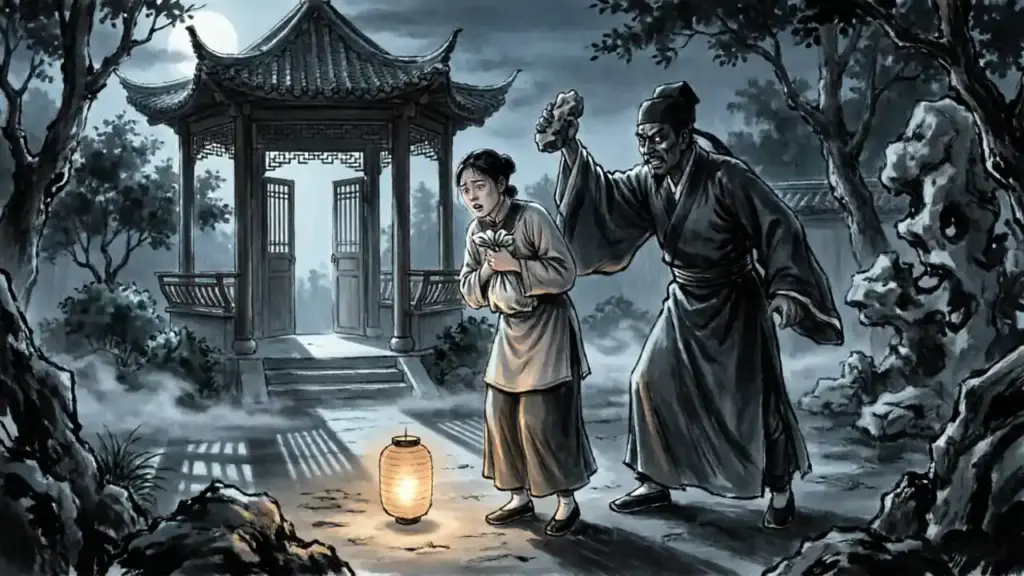
Guangguo had been sleeping in his son-in-law’s study. When word reached him, he staggered into the hall, and grief at once hardened into fury. “My daughter,” he snarled through his tears, “was a creature of iron principle, never sick a day in her life. A sudden death in the black of night—there is a reason. You!” He rounded on Kexin. “You resented her for keeping your brother in her chamber. You resented me for bringing priests to do the rites. Here was your chance. You crept upon her, forced yourself upon her, and she, in her anguish, bit her own tongue and died rather than endure the shame!”
He stormed straight to the yamen and laid his accusation before the prefect, the renowned Lord Bao.
When Kexin heard that Jiang Guangguo had named him before the magistrate as his sister-in-law’s rapist and murderer, a shame so absolute descended upon him that the world seemed to tilt and dissolve. He flung himself before his brother’s spirit tablet, wailing with such force that his heart seemed to crack. Blood surged from his throat, pouring out in gouts, and in moments he collapsed—dead, or so it seemed.
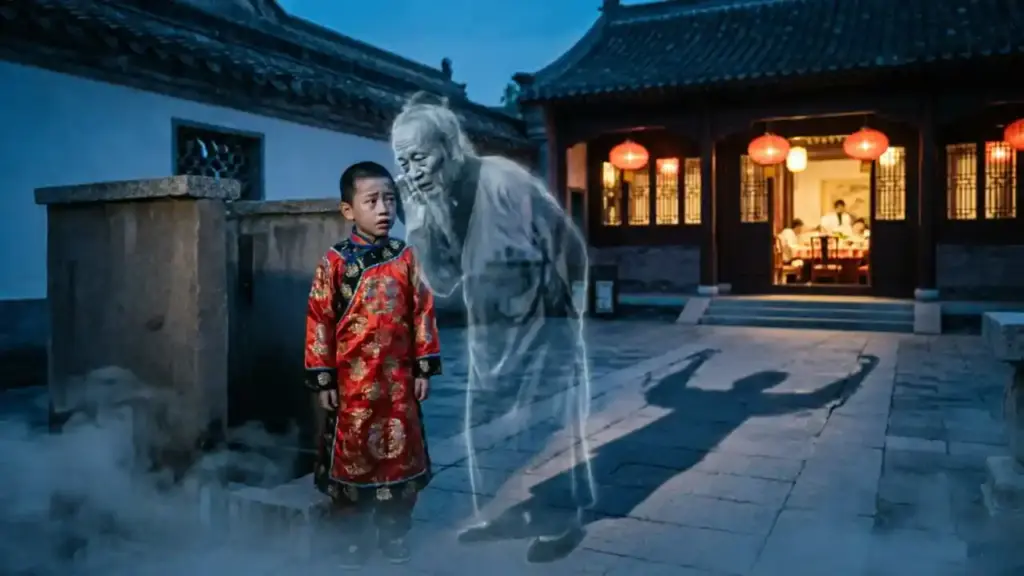
His spirit, loosed from the flesh, drifted into the gloom of the underworld. There he found Kezhong, and fell to his knees, weeping out his agony.
Kezhong’s ghostly face was wet with tears. “The one who drove your sister-in-law to her death,” he said, “was the Daoist Yan. A packet of silver is in the maid Juxiang’s hands—it is the proof. Shuzhen, before she died, entered it in her account book. Take this to the judge, and the truth will blaze forth. You are blameless. My shade will stand beside you in that courtroom. Go back now—go back and live—and afterward, I beg you, perform the rites to lift your sister-in-law’s soul from its torment. Remember. Remember!”
Kexin’s spirit slammed back into his body. A full day had passed; he awoke to find the magistrate’s runners already at the door, sent to drag him before the bench.
Lord Bao unrolled Kexin’s hastily written plea:
“The living die by violence, and the dead know no clarity; but let the dead return, and the living shall stand without shame. My sister-in-law was violated and died—such a death was perhaps inescapable, but it came at the wrong moment. Her father, seeing his daughter dead, brought his charge—such a charge was perhaps inescapable, but it has found the wrong man. I revered my brother as my teacher, served his widow as I would my own mother. Between us, words rarely passed, and every courtesy was strictly kept. I would not have dared a single impropriety—how then could I have conceived so monstrous a violation? The one who shamed her to death was the Daoist Yan. I weep blood at this wrongful accusation. Let the true hawk be snared; let not the wild goose die in the fisherman’s net.”
Lord Bao accepted the plea and summoned the accuser, Jiang Guangguo, to face his defendant.
Guangguo spoke first, his voice shaking with righteous fury: “When my son-in-law lay ill, Kexin wished to move him to the study. My daughter refused, and nursed him in her chamber. After his death, Kexin nursed a deep hatred of her, blaming her for his brother’s end. This was his revenge—he forced himself upon her, and she died of it.”
Kexin answered: “The one who touched my sister-in-law’s body and thus caused her death was the Daoist Yan, no other.”
Guangguo scoffed. “Yan was here but a single day to perform the rites. How would he dare such wickedness, or find the chance? When the ceremonies ended, Yan departed with the others, in plain view of all. This is a phantom story.”
“The priests were many,” said Lord Bao, his voice hardening. “You name only Yan. Where is your proof?”
Kexin wept. “When this slander first fell upon me, the shame was more than I could bear. I beat my head before my brother’s spirit and blood poured from my mouth until the world went dark. In death I met my brother. He told me—Yan killed my sister-in-law. The proof is a packet of silver, now held by the maid Juxiang. My sister-in-law wrote the sum in her ledger. Great judge, look closely, I beg you.”
Lord Bao’s face tightened with fury. “Ghost-talk! You dare to bring such nonsense before this bench?” He ordered Kexin beaten, and the bamboo fell thirty times upon his flesh. Kexin, writhing, cried out, “My brother’s spirit said he would stand at my side in this court! Would I dare lie?”
“If your brother’s spirit holds such power,” the judge roared, “why does it not strike me with a sign?”
And then—a sudden weariness settled over Lord Bao like a heavy cloak. He slumped forward, his head coming to rest upon his desk, and sleep swallowed him.
In the dream, the licentiate Nie Kezhong stood before him, tears streaming. “Your Honor is famed as a mirror of wisdom—how is it you are blind today? The filth who defiled my wife and drove her to her death is the Daoist Yan. My younger brother is blameless. The silver packet in Juxiang’s keeping—that was the reward Your Honor himself bestowed upon me at the seasonal examination. My wife gave it to the priest and entered it in her ledger. The brushstrokes are plain. I pray you, see the truth, swiftly punish the true villain, and set my brother free.”
Lord Bao jolted awake. A long, trembling sigh escaped him. “So it is true,” he murmured. “The spirits do come.”
Turning to Kexin, he said, “Your words were not wild fabrication. Your brother has made the matter plain to me. I will clear this stain from your name.”
Swiftly he sent officers to seize the maid Juxiang. In her possession they found the silver packet—unmistakably the coin given by the court. “How did you come by this?” the judge demanded.
“It fell from my mistress’s robes,” Juxiang stammered, “as they carried her down from the loft. I picked it up from behind, that is all.”
Next, the officers escorted Juxiang to Shuzhen’s chamber and brought back her daily ledger. There, in her own hand, was the entry: silver, five mace, presented as an additional offering to Daoist Yan. The brushwork was unmistakable.
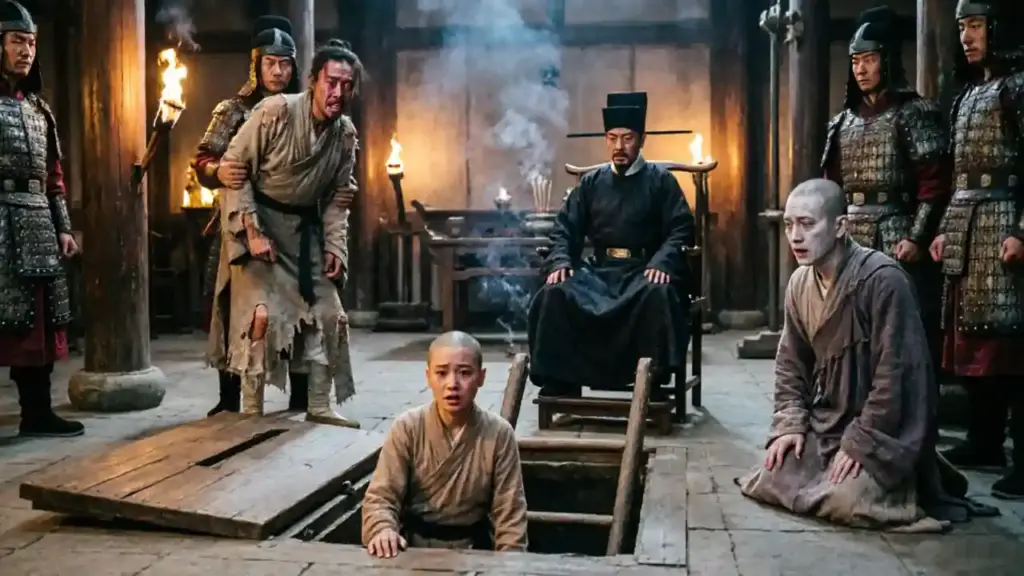
Lord Bao’s men ran Yan Huayuan to ground and hauled him before the bench. A single application of the squeezers, and the Daoist confessed everything: how he had used the wicked aphrodisiac powder, how he had violated the chaste widow until she died, and how, in a final grotesque mockery, he had placed the gift silver in her bosom. He groveled, begging to suffer the penalty, and swore that Kexin had no part in any of it.
Lord Bao pronounced his sentence:
“This court finds that Yan Huayuan, hiding behind the robes of a Daoist, let his heart drown in a sewer of lust. Having accepted the family’s thanks, he announced his departure but crept instead into the shadows, ascended to the loft, and there committed the filthiest of crimes. The wicked powder stripped a virtuous wife of her senses—where, then, was his vaunted purity? Lechery slaughtered a widow still in mourning—what, then, remained of his holy Way? How can such defilement face the Heavenly Venerable? What corner of hell will shelter this karmic debt? Shuzhen, clasping her wrongs to her breast, withered like a blossom in the underworld. Kezhong, sending his dream, became her avenger in the world of men. The silver in the bosom is proof enough; the lines in the ledger do not lie. If Lord Lao himself cannot abide lust in his priests, how much less can the law of the land endure Yan Huayuan’s savage violation? The penalty is death by beheading—let there be no mercy. Nie Kexin is innocent; release him at once to his home. Jiang Guangguo, for his reckless slander that nearly claimed a blameless life, shall bear the punishment prescribed for false accusation.”