In an age when the Emperor’s justice still pierced the shadows of the realm, there lived a Presented Scholar of Chuzhou named Luo Youwen. For years, he had governed Nanfeng County with a steady hand. Far to the south, in Longquan, dwelt his distant kinsman, a Provincial Graduate named Ju Gong. When Ju Gong resolved to visit his esteemed relation, he brought three servants in his retinue: Gui the Eighteenth, Zhang the Third, and Fu the Tenth. Luo Youwen, honoring the bonds of blood, received his guest with the utmost courtesy. Upon their parting, he pressed a heavy purse into Ju Gong’s hands—a gift of one hundred taels of silver.
With half of this fortune, Ju Gong remained in Nanfeng to indulge a collector’s passion. He acquired a stunning array of gilt-bronze curios: censers, brush-stands, ewers, and hair-frames so delicate they seemed spun from spider silk and gold thread. Each piece was a marvel of artisan patience and quiet pride. He nestled these treasures into a leather-bound trunk, securing it with a stout white-brass lock until it was sealed as tightly as a coffin.
Fate, however, had other designs. Lord Bao, the famed Dragon-Brella Envoy, was touring the south, and Ju Gong, counting himself an old acquaintance, resolved to detour and pay his respects. He bid farewell to Luo Youwen and took to the road.
After days of travel, the party reached the river port of Ruihong. Here, Ju Gong split his company. He would travel by water, while Zhang the Third and Fu the Tenth were sent ahead overland to Nanjing to track Lord Bao’s progress, arranging to reunite at the docks of Wuhu.
The next day, as Ju Gong prepared to change vessels, a broad-shouldered boatman named Ge Cai boarded to handle the luggage. He hoisted the leather trunk and felt it drag heavily downward, dense as stone. A sharp, cold thought pricked him: So heavy—nothing but gold or silver could weigh this much. He set the trunk down with deliberate care, masking his surprise, and slipped away to the boat’s master, a man named Ai Hu.
“Those trunks are wrong-heavy,” Ge Cai murmured, pulling the master into the cabin’s shadows. “I know the heft of silk and books. That box is stuffed with precious metal. I’d stake my life on it.”
Ai Hu’s eyes kindled with a greasy, dark light. They conferred in whispers that might have curdled milk, until Ai Hu gave voice to the thought. “This trip, we take no other passengers. No idle travelers, no gossiping merchants. We need the river empty and the night blind.”
The plan set, they returned to Ju Gong wearing smiles as warm as fresh bread. “You are a gentleman of letters,” Ai Hu said with a bow. “You will cherish peace. To cram the boat with chattering strangers would be an insult to your dignity. We shall carry no one else, trusting entirely to your generosity at Wuhu.”
Ju Gong, possessing a scholar’s unworldly trust in the decency of men, was moved. “That is very well,” he said. “At Wuhu, I shall reward you handsomely.” The two river-wolves exchanged a glance, and in that silence, the deed was sealed.
They cast off, passing Jiujiang without incident. On the second night, Ai Hu steered into a deserted bend where reeds grew thick and darkness hung like a shroud. In the dead hour after midnight, with the moon smothered in cloud, Ai Hu drew a blade. Ge Cai raised his own. They moved in perfect, murderous concert. Ai Hu’s steel bit into Ju Gong’s skull; Ge Cai’s severed the neck of Gui the Eighteenth. Master and servant died without a cry, their breath snuffed out before it could shape a sound. The killers heaved the bodies over the side. The indifferent river swallowed them with two dull splashes, closing over their heads without a ripple.
Breathing hard, the men wiped the blood from their hands and found the key in the dead man’s robes. With trembling, greedy fingers, they unlocked the trunk. The lid swung open—and they stared.
No piled ingots. No shimmer of silver sycee. The trunk was filled with bronze: censers, vases, kettles, and those delicate golden-thread hair-frames. Beautiful, yes, but bronze for all that. Beneath them lay a paltry thirty taels of loose silver.
Ge Cai sagged to the floorboards, a mask of disgust. “I wagered my soul on a trunk of treasure,” he groaned, “and this is what we get?”
But Ai Hu, turning a bronze in the lamplight, let out a slow, calculating breath. “You don’t understand. Goods of this quality will find a buyer anywhere. We hold our course for Wuhu. We’ll sell them piece by piece, and turn bronze into silver yet.”
Meanwhile, Zhang the Third and Fu the Tenth reached Nanjing only to find Lord Bao had moved on to Suzhou. They hurried to Wuhu, waited a fortnight, and felt a cold dread creep into their bones. Penniless, they sold their clothes for copper and scoured every dock from Nanjing to Songjiang. There was no trace.
Desperate, they resorted to a stratagem. On a day when Lord Bao opened his gates to petitions, they slipped among the crowd, knelt before the dais, and presented their plea.
Lord Bao read the paper, a shadow passing over his face. “Where did you last see your master?”
Zhang the Third recounted the journey, the purchase of the bronzes, the parting at Ruihong. “We have spent our last coin, Your Excellency. We resorted to this ruse only because we could not bear to stand idle while our master’s fate remained unknown.”
Lord Bao was silent. “After your parting, might he not have turned home?”
“Never,” Fu the Tenth shook his head. “His whole purpose was to seek you.”
“How much silver did he have?”
“One hundred taels. Fifty were spent on the bronzes.”
Lord Bao nodded slowly. A picture was forming. “Your master is not a man to sit idle. If he has not gone home, then either the river has swallowed him, or foul hands have done their work. I give you an official warrant and two taels for your journey. Go back along the river. Search every market, every pawnshop. Whoever took those goods must sell them. The moment you find bronzes or hair-frames of uncertain origin, seize the seller and bring him before the nearest magistrate. From there, he shall be brought to me.”
With the warrant tucked securely into their robes, the two servants set out once more. They traced the river’s winding course from town to town, haunting the wharves and marketplaces, interrogating every dealer in metalwork and curios. For many weary weeks, they found nothing but dead ends. Their silver dwindled to a few lonely coins. At last, they drifted back into Nanjing, footsore and threadbare, their hope worn as thin as old gauze.
And then, on an ordinary street, on an ordinary afternoon, Zhang the Third stopped dead. Through the open front of a shop, his eye had caught the gleam of a gilt-bronze censer sitting upon the counter. He clutched Fu the Tenth by the arm, and together they drew closer. The shape, the chasing, the peculiar richness of the gilding—every detail shouted with a voice they knew.
They stepped inside. “Is this censer for sale?” Zhang the Third asked, keeping his voice steady.
The shopkeeper glanced up. “It is.”
“Do you have other curios of this kind?”
“I do,” the man replied. Sensing a serious customer, he brought out the leather trunk and opened it before them. Zhang the Third felt his heart hammer against his ribs. There they were: the vase, the brush-stand, the ewer, the gold-thread hair-frames—every piece accounted for, down to the last delicate filigree. It was all his master’s property, as though the dead man himself had just stepped out of the room.
“Where did you source these goods?” Zhang the Third asked, the words tight.
“From Wuhu,” the shopkeeper said offhandedly.
Before he could draw another breath, Fu the Tenth lunged and seized him by the collar. The shopkeeper let out a cry of shock and fury. “What is this? Broad daylight, and you lay hands on me?” A scuffle broke out, and a crowd began to gather, their voices rising in confusion.
At that precise moment, a mounted patrol under the command of Commander Zhu Tianlun rode into the street. Hearing the commotion, the commander wheeled his horse and pushed through the throng. “What disorder is this?” he demanded. Fu the Tenth released his grip at once, and Zhang the Third fumbled for the warrant, holding it high with both hands. Commander Zhu read it, and his expression hardened. He ordered the whole party—the two servants, the shopkeeper, and the trunk of goods—removed at once to his yamen for examination.
Under questioning, the shopkeeper, whose name was Jin Liang, turned pale as wax and stammered that the goods had been bought from his brother-in-law, Wu Cheng, who dealt in wares from Wuhu.
“These are clearly Nanfeng goods,” Commander Zhu said coldly. “There is something rotten here.” He ordered Wu Cheng brought in. Under the rod, Wu Cheng confessed that he had purchased the pieces from an unknown traveler in Wuhu for forty taels, through a middleman, a broker named Duan Keji.
Commander Zhu, sensing a crime far deeper than petty trafficking, dispatched the prisoners—Jin Liang, Wu Cheng, the two servants, and the broker Duan Keji—under guard to Lord Bao for final judgment.
By this time Lord Bao had moved on to Taiping Prefecture, and the press of his official duties left him no leisure to try the case himself. He handed the matter to Magistrate Dong, a man known for his sharp wits, with orders to conduct a full hearing and report.
Magistrate Dong ascended the bench and received the formal plaints. From Zhang the Third and Fu the Tenth came a cry of blood and sorrow: their master, they wrote, had been murdered for gain, his body consigned to the river, his goods brazenly sold in the marketplace. From Wu Cheng came a plea of innocence: he was a lawful trader who had bought the wares openly, through a licensed broker, with no knowledge of any crime.
The magistrate summoned Duan Keji and questioned him sharply. “You acted as middleman in this sale. Who was the original seller?” But the broker only spread his hands. “Merchants come and go like mayflies. How can I remember every face?”
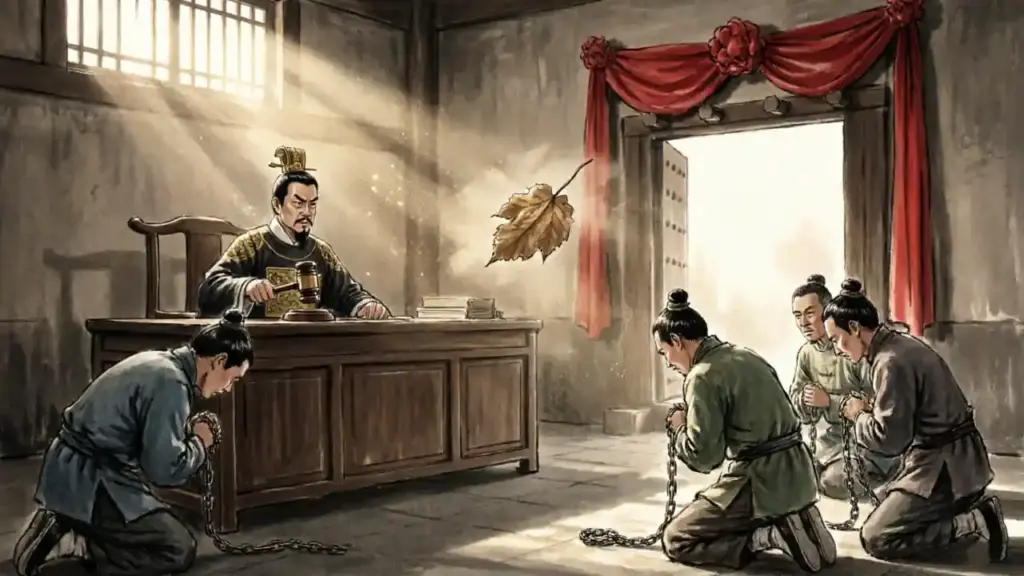
Magistrate Dong brought his gavel down with a thunderous crack. “This case has been personally entrusted to me by Lord Bao. A man’s life hangs in the balance. If you know the truth and conceal it, you are no better than an accomplice.” Yet Duan Keji and Wu Cheng merely pointed trembling fingers at one another, each insisting the other held the key. The magistrate ordered the rods brought out. Both men were beaten until their backs ran with blood, yet they clung to their silence.
As the magistrate was retiring from the bench, a strange thing occurred. Passing beneath the portico, he felt a sudden, inexplicable gust of air. Out of nowhere, a single dried leaf—a leaf of the kudzu vine—came drifting down and settled upon the red ceremonial cloth that hung above the doorway. The cloth shifted, slipped from its fastening, and fell in a soft, rustling cascade, draping itself entirely over the broker, Duan Keji.
Magistrate Dong froze. He stood quite still, staring at the leaf and the cloth. There was not a single kudzu vine planted anywhere in his yamen. Where had the leaf come from? He turned the image over in his mind as he retired to his chambers, but no answer came.
The next day, the prisoners were tortured again. They would not confess. Baffled, Magistrate Dong drafted a preliminary report to Lord Bao, who read it and returned it with a sharp note: Investigate thoroughly and report again. At the same time, Lord Bao appointed the magistrate to conduct an audit of granaries in several neighbouring counties, including Yizheng. Magistrate Dong set out at once.
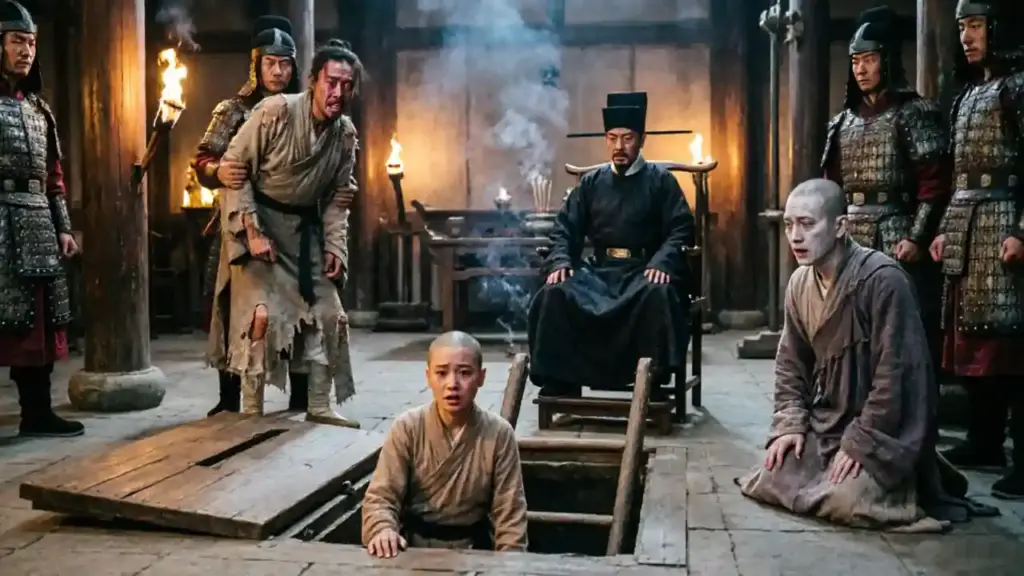
When he reached the Wuhu river crossing, he prepared to change boats. His runners went down to the dock to commandeer an official vessel, and the boat they seized belonged to none other than Ai Hu. As the magistrate stepped toward the gangplank, he asked offhandedly, “What is your name?”
“This humble one is called Ai Hu,” the boatman answered, bowing low.
The magistrate’s eyes shifted to the deckhand. “And that man there?”
“He is Ge Cai, the oarsman.”
The names struck Magistrate Dong’s mind like a pair of hammer blows. Ai Hu—Ge Cai. He repeated them soundlessly on his tongue, and then, with the force of a lightning strike, the image of the drifting leaf blazed before him. Ge Cai—the name was the echo of the leaf. Ge ye piao lai—the drifting kudzu leaf. The leaf had been a sign, a message blown from the spirit world itself.
He planted his foot on the gunwale, then snatched it back as if bitten. “Seize them!” he roared. “Seize them both!” Before Ai Hu or Ge Cai could so much as twitch, the runners swarmed over them, bound them hand and foot, and hauled them off the boat.
Magistrate Dong returned at once to his temporary tribunal and began the interrogation with the gavel already shaking the table. “Your murder of the Provincial Graduate has long been known to this court! The broker Duan Keji has already given you up. The officers have been hunting you for months. You will confess now, or be flayed where you kneel!”
Ai Hu summoned a desperate bravado. “This is a monstrous injustice! I am a simple boatman. I have never met this Duan Keji in my life. Why should he slander me?”
The magistrate ordered forty strokes of the heavy bamboo. Still the two rivermen held their tongues. Magistrate Dong consigned them to the prison of Wuhu County and continued his official tour. When he returned, he had them brought to the tribunal once more and subjected to a fresh round of torture. At last, with their flesh in ribbons, Ai Hu broke.
“I will confess!” he sobbed. “It was Ge Cai’s idea. When the scholar came to hire the boat, Ge Cai lifted his trunks and felt the weight. He was sure it was treasure. We agreed to take no other passengers. That night, below Hukou, we anchored in a desolate spot. In the middle of the night, we fell on them with knives and threw them overboard. But when we opened the trunk, there was no treasure—only bronze and a few taels of silver. We were sick with regret, but it was done. At Wuhu we sold the goods cheap, to be rid of them fast, and Wu Cheng gave us forty taels. Duan Keji guessed the truth and extorted fifteen taels from us as his share.”
When these words were spoken, Duan Keji’s face went slack and grey. He lowered his head and could say nothing at all. The prisoners were ordered to sign their confessions. Zhang the Third and Fu the Tenth fell to their knees and wept aloud. “Blue Heaven above! Our master’s ghost can rest at last.”
Magistrate Dong drafted a full report and submitted it to Lord Bao, who reviewed the case in person. Every prisoner repeated the confession without a single retraction. Lord Bao took up his brush and wrote the final judgment:
Ge Cai first gauged the weight of the luggage and conceived a wolf’s greed. Ai Hu then heard the talk of profit and nursed a murderer’s heart. They feigned solicitude about boat-fare, the better to plumb the victim’s purse; they refused all other passengers, the better to spring their hidden snare. They moored in a deserted spot where no witness could see; they struck in the dead of night with blades that gave no warning. They flung the dead into the river, erasing all trace of their crime. They dreamed of a trunk brimming with gold, but found only bronze, and so were driven to hawk their plunder at Wuhu. A broker smelt the taint and claimed his cut; the goods passed to a Nanjing shop, where faithful servants knew them at a glance. The murderers’ names were unknown, but a drifting kudzu leaf spoke from heaven; the guilty men might have fled, but a chance boarding of an official boat forced their own lips to speak. The leaf that fell was no dead thing—it was the finger of fate pointing straight at the killers. Now seized and broken under torture, they have proved to be the very authors of the crime. For Ge Cai and Ai Hu, who slew for gain and sank to the depths of depravity, the sentence is death by public beheading. For Wu Cheng and Duan Keji, who knew the goods were stained with blood and yet divided the spoils, the sentence is exile to the farthest frontier. The shopkeeper Jin Liang is blameless and shall be released forthwith. Let all be carried out as decreed.When autumn came, Ge Cai and Ai Hu were led to the execution ground and beheaded before a watching crowd. Wu Cheng and Duan Keji were sent in chains to the distant borderlands. And the souls of Ju Gong and his loyal servant, which had cried out from the darkness of the riverbed, were at last given peace—all through the silent testimony of a single drifting leaf.